Archive for the ‘Control and Monitoring’ Category
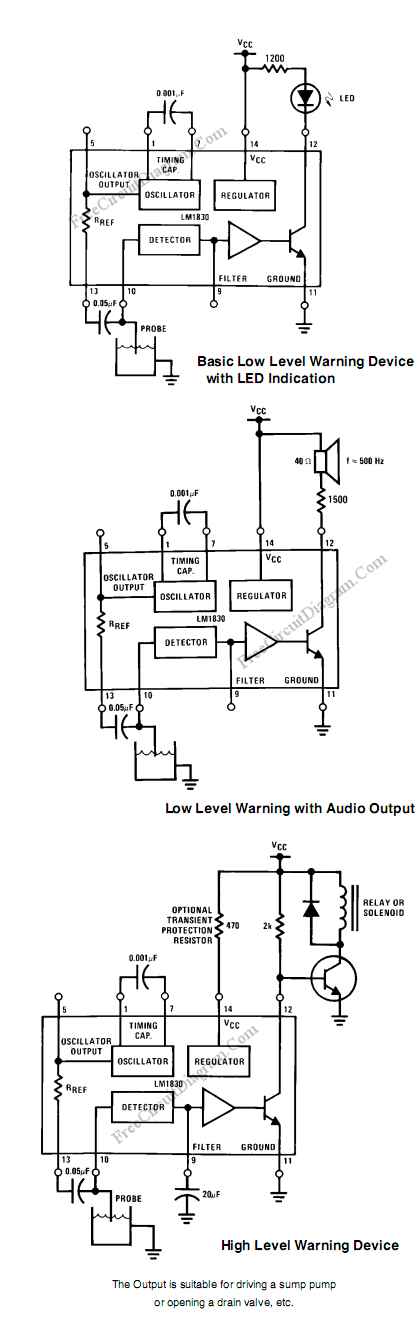
Water Level Controller

Water level controller circuit described here control the water level inside a tank. There two modes available with this water level controller circuit. The first mode is empty mode, when the controller will drain the tank if the water level reach the upper limit, the pump will be used to suck the water from the …[Read More]
Simple Stepper Motor Controller

Stepper motor controller is needed to run a stepper motor, since a stepper motor cannot work by just connecting it to a power supply. To program a stepper motor to make a complex movement, we usually need a micro controller. Fortunatelly, for a simple movement like just rotating eith a constant speed, we can use …[Read More]

The temperature of a quartz crystal for oscillator should to be kept constant to operate at very stable frequency. This oven temperature controller is suitable for such purpose. Here is the schematic diagram of the temperature control circuit: Although this circuit is small and simple, the design use a PWM output to preserve the efficiency. …[Read More]
Simple PWM Circuit Using Inverter Gates

This PWM circuit needs only two inverter gates, so you can build up to 3 independent PWM circuit using only one IC chip, since there are at keast 6 inverter gates in one IC package. Here is the schematic diagram of the circuit: Please remember that you should connect any input pins of any unused …[Read More]
PWM Motor Control With Forward, Reverse, and Break Operation

This PWM motor control circuit provides many controls for DC motor. You can control the DC motor to rotate forward, reverse, or break until it stops. Here is the schematic diagram of the circuit: The circuit uses MOSFETS bridge to drive the motor, controlled by some logic gates and small bipolar transistors. The motor voltage …[Read More]
Battery Current Monitor Circuit, A Single Supply Operation

By detecting a voltage drop in resistor connected in series with the battery, we can measure the current flowing in or out of the battery. A simple differential amplifier do that, but we need both positive supply and negative supply to sense the current in both direction, the current when charging and discharging the battery. …[Read More]
Current Sense Circuit, A Classic Design Using Positive Rail Sensing

A LT1637 is advertised as 1.1MHz, 0.4V/us Over-The-Top Micropower, Rail-To-Rail Input and Output Op Amp. This features are suitable for current sensing application since input voltages are right at the upper rail. The circuit show current sensing of 5V supply system, but monitoring up to 44V application can be done by this circuit (the maximum …[Read More]
|