Bulk Transistor Tester – An Easy Transistor Gain Classifier
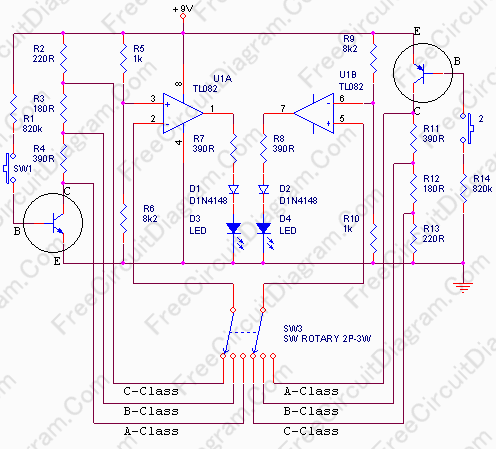
This transistor tester is very helpful if you need to sort bulk transistors. In some market, if you know where to find it, sometimes you can get transistors sold in kg unit, not in single peaces unit. You can buy 1 kg of transistors with really cheap prices. Don’t be too happy right now because you have to be careful, since there’s no guarantee all of your transistors will works. Using the circuit described below, you life will be much more easier because you can sort your cheap bulk transistor easily.
If you set SW3 to class C position and the LED lights then put the transistor in the “C basket”, a basket for transistors with current gain 500 or more. If it doesn’t light then switch the SW3 to class B position, if the LED lights then put the transistor in the B basket (current gain 270-500). If it doesn’t light then switch to class A position. If now the LED lights then put your transistor in the A basket (140-270 current gain). If in this last switch position the LED doesn’t light then put your transistor in the waste basket, hope that someone will recycle it for better green environment.
The mechanism is very clear, the base current (9V-Vbe)/R1 is amplified by the transistor, and converted to voltage by Resistor R2 for class-C position, R2+R3 for class-B position, and R2+R3+R4 for class-A position. The voltage then compared to a 0.97 Volt reference (set by R5 and R6), the comparator output then connected to a LED for indication. If you ask for what purpose the D1 and D2 are, they are there to make sure that the LEDs won’t be turned on if the op-amp’s output going to low, since the “low” level for them might be as high as 2 Volts in some cases.