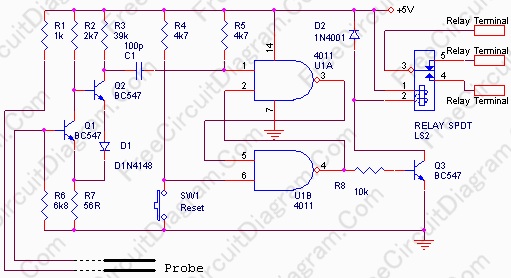
You can use a humidity sensor to give an alert of boat leakage, or when your books start being flooded by heavy rain attack on your broken roof, or anything you can imagine. A simple humidity sensor (a humidity probe) can be constructed using two copper wires placed as close as possible to each other, but no touching. This simple circuit can be used to make your simple humidity detector. The circuit schematic diagram is shown below.
If the humidity increase, the probe resistance will drop and the Schmidt trigger formed by Q1 and Q2 will be triggered, and the Q2 collector become low, this condition will trigger the S-R (set-reset) flip-flop formed by U1A, U1B. After triggered, the relay will remain active until you reset the circuit by pressing the SW1 switch.
Possibly Related Articles:
- LM1830 Single Chip Water Level Sensor Circuit: Basically A Conductive Liquid Level Sensor
For any electrically conductive liquid level measurement, this single chip circuit is very compact and simple. This circuit is an ac excited fluid level sensor, which uses alternating current to... - Fahrenheit Thermometer Using LM35 Temperature Sensor IC
If you have a digital voltmeter, or any voltmeter with millivolt resolution and high input impedance, then you can use this temperature-to-voltage adapter circuit to measure room temperature. Here is... - Current Loop Transmitter For Temperature Sensor
Current loop interface has been widely used in industrial environment because it's robustness. Noise resistance and fail detection capability made it suitable for long distant transmission in harsh environment. This... - Simple Touch Switch Using 555 IC
This 555 circuit will activate a buzzer and turn on a LED lamp when you touch the probe. Here is the circuit's schematic diagram: lf you touch the plates, the... - Simple Transistor Tester Using 555 IC
Testing whether a transistor is shorted or open usually done by ohm meter. You test if the base to emitter or collector permit a current flow in one direction. Here...


| DESIGN BY