Single Supply Octave Shifter: A Frequency Doubler Effect For Electric Guitar
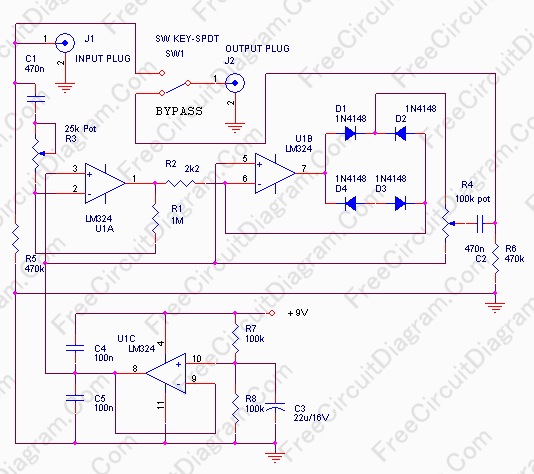
Octave shifting or frequency doubling effect for electric guitar is done by rectifying the original signal, just like AC to DC conversion inside your AC-DC power supply adapter. The circuit for this audio effect is not new, I’ve seen it on many publications. Here I present the circuit’s schematic diagram, but I’ve redesigned the circuit to use single supply instead of symmetric power supply. Thanks to the LM324 low voltage design because we can design the circuit for standard guitar effect’s 9V power supply.
Look at the above schematic diagram, you can see the rectifying is done by four 1N4148 silicon diodes, configured as full-wave rectifier bridge. Because the bridge is inserted inside the negative feedback of the operational amplifier (op-amp) U1B, the nonlinear characteristic of the diodes around the turn-on point (the forward bias voltage) is compensated by the op-amp’s feedback mechanism. As the result, the output of the rectifier looks like coming from ideal diode with no bias voltage needed.
You can variate the pre-amp gain by adjusting R3 potentiometer between clean and slightly overdriven, hear the effect, and set as you want. The R4 pot is provided to adjust the processed signal so the output level after the frequency doubling is equal to the level before entering this analog effect processor. This important as we provide the circuit with bypass switch to give an option for the player to change the mode between clean and doubled on the fly, and normally we don’t want the effect make any volume jump after toggling the clean-effect modes.
Make R7, R8, and C3 layout as close as possible to the pin 10 of the LM324 IC (U1C) with shortest possible wiring to minimize capturing any noise. This voltage (at pin 10 U1) is the reference for internal “virtual ground” coming out from U1C output (pin 8). Make sure that the PCB tracks for this “virtual ground” (pin 8 U1) are wider than other signal tracks to give consistent reference for all op-amps. Make sure C4 and C5 have the shortest possible connection to the power pins (pin 4, pin 11) and the “virtual ground” line (pin 8).
Here is the parts list:
[TABLE=6]