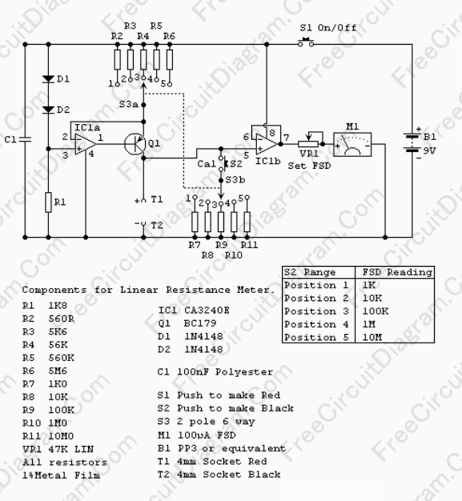
Many analog ohm meters have non linear scale, so the resolution become worse at higher resistance value. This because they use cheap current source, only a series resistance to approximate an ideal current source. An ideal current source will force a consistent current amount regardless of the tested resistor value. Using regulated current source, the current flowing through the tested resistor will be kept constant, so the measured voltage across the tested resistor is proportional (linear) to its resistance value. The circuit diagram is shown below:
The current source is provided by IC1a. The two 1N4148 diodes give a constant reference, so the voltage across selected R2..R6 is constant at about 1.4 volt. The R1..R6 is selected to measure different resistor ranges. The VR1 has to be adjusted every time you switch for different range, just like as you do in your old classic analog ohmmeter.
Possibly Related Articles:
- Programmable Current Source/Regulator
This is a simple circuit of programmable current source/regulator. This circuit is used to generate current. Here is the schematic diagram of programmable current source/regulator : This circuit uses L... - Low-Drop-Out (LDO) Low-Voltage Linear Regulator Using NCP2860 IC
This low drop out (LDO) voltage regulator need only few components, with very low noise and very low drop-out voltage. The circuit illustrated in the schematic diagram below gives a... - Linear TEC (Thermo Electric Cooler) Driver
Thermoelectric cooler (TEC) or Peltier cooler is becoming popular because of its robustness and maintenance free characteristic. Here is one example of a linear thermoelectric cooler (TEC) driver circuit. This... - PWM to Amplified and Buffered Linear Signal Converter
This is a simple circuit that can be used to convert a low-voltage PWM signal into a buffered and amplified linear output. This circuit is designed for fan speed control.... - Circuit Converts PWM Fan Drive to Linear and Reduces Acoustic Noise
We usually use a fan to manage the temperature, but it produces audible noise at full speed. To reduce this noise we can use this circuit. The first circuit reduces...

|