Function Generator Using CA3080 and CA3130 Op-Amps
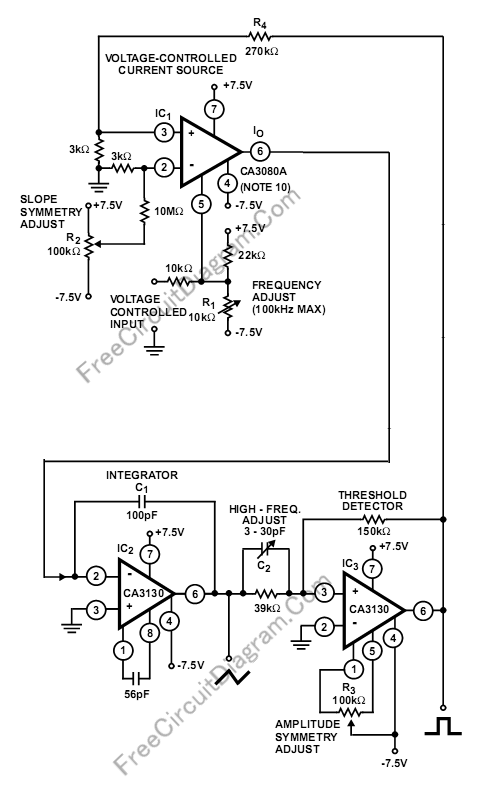
The schematic diagram shown in the figure below show a function generator circuit using CA3130 in the integrator the threshold detection sections. Both triangular and square-wave signal are available from this circuit’s output, ranging from 0.1Hz to 100KHz (1:1000000 ratio). This frequency adjustment is done only by a single control R1. A voltage control input is available for externally-controlled frequency sweep.
The core of this function generator circuit is an operational-transconductance-amplifier (OTA) CA3080A, operated as a voltage-controlled current source. The current output Io is applied directly to an integrator IC2, and this integrator produce a triangular waveform. The potentiometer R2 is used to adjust the symmetry of the positive and negative ramp.
The controlled switch constructed around IC3 (CA3130) set the excursion of the triangular output from the integrator, with C2 capacitor to optimize the high-frequency square-wave output performance.
Potentiometer R3 is used to fine tune “amplitude symmetry” of the square-wave output signals. The output of the threshold detector IC3 is fed back through resistor R4 to the input of lC1 to toggle the current source from plus to minus in generating the linear triangular wave. [Circuit’s schematic diagram source: Harris Semiconductor’s CA3130 Application Notes]