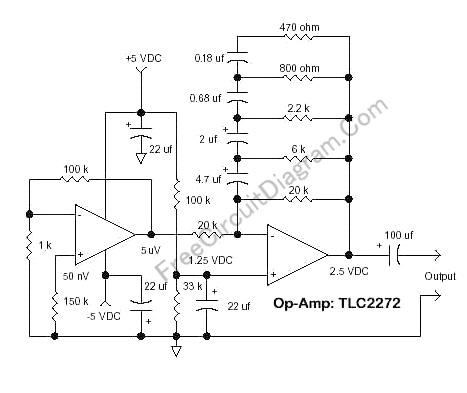
The circuit’s schematic diagram shown in the figure below is a flicker noise generator, an implementation of flicker noise analog modeling presented in NBS technical note #604, “Efficient Numerical and Analog Modeling of Flicker Noise Processes” by J.A. Barnes and Stephen Jarvis, Jr. With the component values shown the schematic diagram,  the circuit will give a 1/f noise slope from below 1Hz  to over 4KHz. A TLC2272 op-amp is used for this circuit, but any low noise op-amps will work. The op-amp must be a low noise type because the noise generation come from a high value resistor generating about 50nV noise. Use an op-amp with noise voltage less than 15 nV/root-Hz and noise current less than 0.1 pA/root-Hz, an easy-to-find feature in many low-noise modern op-amp devices. To simplify the construction, the capacitor values is slightly different from the calculated values described in the paper, and a bias circuit is provided to allow the use of polarized electrolytic capacitor. Because the electrolytic capacitor has poor tolerance, it should be chosen carefully for best performance.

pink noise generator circuit schematic

Compared to circuit utilizing deode zener, reverse-biased transistor, or other noisy devices, this circuit give more predictable and repeatable output level.  If we tap the output of the first op-amp through a 100uF capacitor (like as seen in the second op-amp), a precise 5uV/root-Hz white noise will be there as an excellent signal source for audio noise measurement calibration. At the second op-amp, this white noise is filtered to give a flicker noise (pink noise) frequency speectrum, since the pink noise is a subset of white noise in the frequency domain. [Circuit's schematgic diagram source: techlib.com]


Possibly Related Articles:

  • Low Cost Noise Generator
    White noise is a random signal (or process) with a flat power spectral density. In other words, the signal contains equal power within a fixed bandwidth at any center frequency....
  • Broadband Random Noise Generator
    Random noise source is often needed in testing many type of electronic systems such as filter, audio, or RF communication. The circuit presented here generates an RMS amplitude regulated noise...
  • Cuckoo Sound Simulator (Synthesizer/Generator)
    A two tone effect very much alike cuckoo sound is generated by this circuit. We can use this circuit for door-bells or other purposes thanks to a built-in audio amplifier...
  • Low Noise Microphone Pre-Amp with Op-Amp
    Microphone pre-amp is a very simple circuit, most all low noise op-amp will be sufficient for this circuit (TL071, TL082, OPA371, NE5534, etc). This circuit will be suitable for dynamic...
  • Eliminating LED Pop/Click Noise
    Typical LED indicator consist of resistor (R2) and LED, connected in series with a switch.  When the switch is closing or opening, a glitch noise may occur at the supply...
  • Low Noise Audio Line driver
    LT1206 has been naturally selected as the components for video application since it has suitable bandwidth and output derive capability. This high performance features  is not only suitable for video...
  • Hum Filter, An Ultimate Weapon To Remove AC Line Noise
    You might think that hum noise is produced by electronic device with improper design, yes you’re right. And you might choose to solve the trouble maker, the source. You begin...
  • LM1894: Single Chip Dynamic Noise Reduction System (DNR)
    The LM1894 is a stereo noise reduction circuit suitable for audio playback application. The DNR system is non-complementary, meaning that it does not require encoded source signal. The system is...
  • Stable 60 Hz Frequency Signal Generator
    A 60Hz signal generator can be useful in testing your circuits. You can test your notch filter, simulating hum noise, or you can use it as part of your DC-to-AC...
  • PC (Audio) Signal Generator Using RS232 Port
    Using an RS232 port, we can generate square wave oscillation when transmitting data, and this can be “misused” as signal generator (square wave generator). This is a PC Signal generator...
  • High Noise Immunity for Data Transmission with VFC
    It is advantageous to convert the analog signal into a digital signal, which is less susceptible to noise pick-up when transmitting analog data over long distances. It is very easy...
  • Circuit Converts PWM Fan Drive to Linear and Reduces Acoustic Noise
    We usually use a fan to manage the temperature, but it produces audible noise at full speed. To reduce this noise we can use this circuit. The first circuit reduces...