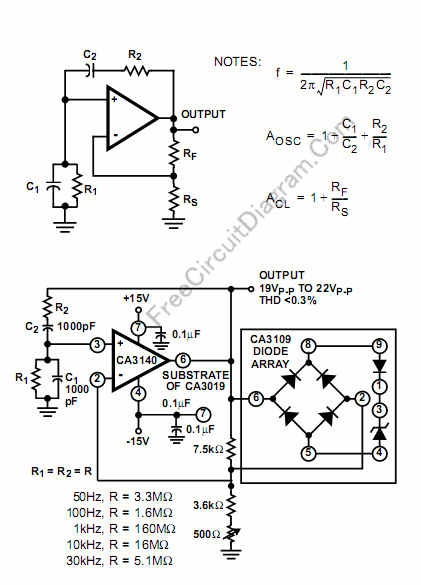
The excellent high input impedance, high slew rate, and high voltage qualities of CA3140 op-amp make it suitable for Wien-bridge sine wave oscillator. The basic circuit for Wien-bridge sine wave oscillator is shown in the figure below (the upper part). You can see the formula in the figure, when R1=R2=R, and C1=C2=C, then the formula would be a very simple and familiar f = 1/(2piRC) , and the gain required for oscillation, AOSC, is equal to 3. If C2 is multiplied by a factor of four and R2 is divided by a factor of four, the gain required for oscillation becomes 1.5, thus a potentially higher operating frequency closer to the gain bandwidth product of the CA3140 becomes possible. Here is the circuit’s schematic diagram:
The oscillation stabilization should be done, and various methods has been implemented in practice. If this the gain is not stabilized the the oscillation will either diminish or increase until distorted terribly. The feedback element RS is usually replaced with some variable resistance element. Thus, using some control methods, the value of RS is dynamically adjusted to keep constant oscillator output. A thermistor, a FET channel resistance, a lamp bulb, or other device whose resistance increases as the output amplitude is increased are a few common elements that has been implemented for this purpose.
The lower figure shows another method to stabilize the oscillator using a zener diode which shunt the feedback resistor to decrease the op-amp gain. The zener diode’s impedance will decrease as the output signal amplitude increases, resulting in more feedback with consequent reduction in gain, stabilizing the amplitude of the output signal. Using this method which employ a combination of monolithic zener diode and bridge rectifier circuit tends to provide a zero temperature coefficient for this stabilization system.
Unlike lamp bulb that has thermal time constant or RC network that is usually used in detector networks, there’s no lower frequency limit in this circuit since the bridge rectifier system has no time constant. As an example, using 1µF polycarbonate capacitors and 22M for the frequency determining network, the operating frequency would be 0.007Hz. To prevent the output signal from becoming slew-rate limited, the amplitude should be reduced as the frequency is increased. An output frequency of 180kHz will need a 9V/µs slew rate when its amplitude is 16VP-P. [Circuit's schematic diagram source: Intersil's CA3140 Op-Amp Application Notes]
Possibly Related Articles:
- Square Oscillator Using Comparator: The Circuit Schematic Diagram and The Formula
Using a single supply quad comparator LM339, LM239, LM2901, LM2901V, NCV2901, or MC3302, we can build a square-wave oscillator with simple circuit and formula. Here is the schematic diagram: This... - First Order Low-Pass Active Filter: The Circuit Schematic Diagram and The Design Formula
The simple low-pass filter is shown in Figure below. The filter has a 20dB/decade roll-off after its corner frequency fc. Its low-pass frequency gain (f->0) is defined by R3/R1. This... - Wien-Bridge Oscillator Using HA2541 Op-Amp
A Wien-Bridge oscillator circuit can be built from HA2541 and some basic components. This circuit can generate good-quality sine wave of 40 MHz with an upper limit of 50 MHz.... - Wien-Bridge Oscillator Using Incandescent lamp Stabilizer
Incandescent lamp has been used to reduce harmonic distortion in sine oscillator circuit. The nonlinear resistance characteristic of the lamp filament help the circuit to shape the signal to approximate... - Baxandall Tone Control Using LM833: The Circuit’s Schematic Diagram and The Formula
This circuit is similar to our previous tone control circuit, a bass-treble tone control circuit, but here we present the formula for design your tone control’s custom frequency response. Here... - Notch Filter: The Circuit’s Diagram and The Design Formula
Notch filter is known as band-cut filter or band-reject filter. The fuction of this filter is to remove some frequency portion of a signal. The schematic diagram of this filter... - Differential Low-Pass Filter and The Design Formula
Multiple Feedback (MFB) is the best filter topology to use for differential low pass filters. Here’s the circuit diagram: To design this filter, a corner frequency is chosen based on... - Sine Wave Oscillator Circuit Using Phase Shifter
Sine wave oscillator can be implemented using Wien-Bridge oscillator like in our previous sine wave oscillator circuit, but now we present another method of generating sine wave signal. Using phase... - Butterworth Second Order High-Pass Filter: The Circuit and The Formula
For high pass filter, this circuit is similar to low-pass filter circuit, but the position for resistors and capacitor are interchanged. Here is the circuit’s schematic and formula: Similar with... - Dynamic Compressor, Self Powered Circuit Design
This dynamic compressor will give about 20dB compression, at very wide input signal range 100 mV to 10 V. Another advantage of this circuit is that this circuit doesn’t need... - 1st-order-3-Way Crossover Circuit Design Using Free Online Tool
Designing passive crossover network for your speaker system is easy, just like what shown in our previous crossover design article, but now we can design many types of crossover even... - Single Chip Stereo FM Transmitter Circuit: A Very Compact Design
ROHM (www.rohm.com) is originally a resistor producer company, but finally expand their business and produce monolithic IC, and this one used in our circuit is the example. The internal structure...

| 

