LM1830 Single Chip Water Level Sensor Circuit: Basically A Conductive Liquid Level Sensor
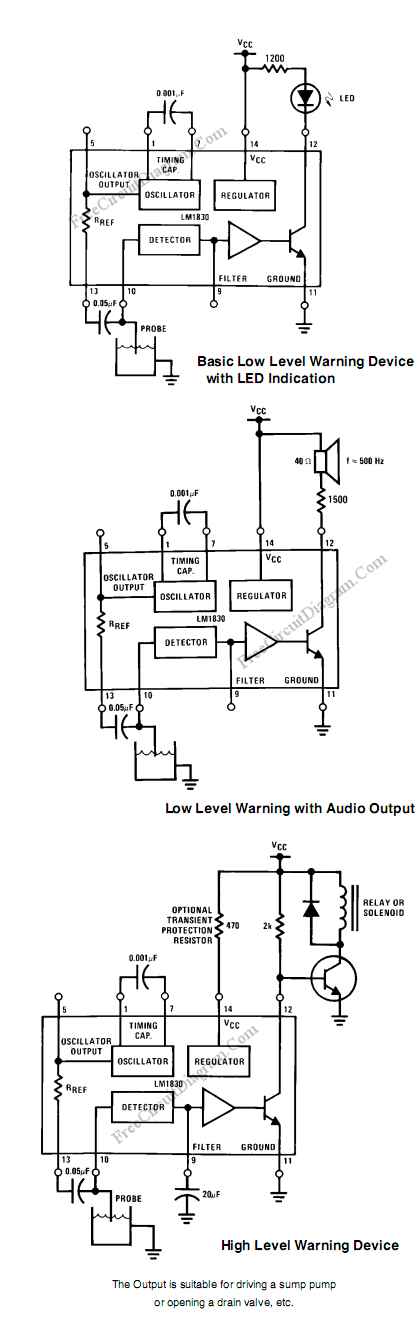
For any electrically conductive liquid level measurement, this single chip circuit is very compact and simple. This circuit is an ac excited fluid level sensor, which uses alternating current to provide biasing for the sensor probe to avoid electrolysis of the probes. This ac excitation makes the sensing probe has longer lifetime. This circuit can be useful for wide range of water or liquid level sensing and control such as radiators, beverage dispensers, washing machines, water softeners, irrigation, reservoirs, boilers, aquarium, or sump pumps. Many type of fluids are electrically conductive and can be detected using this liquid level sensor circuit: city water/ground water, sea water, chopper sulfate solution, weak acid, weak base, household ammonia, water and glycol mixture, wet soil, coffee, or fruit juices. Remember that most of fuel doesn’t conduct electricity, so this circuit can be employed as fuel level sensor/detector. Some other liquids that is non conductive are: pure water, gasoline, oil, brake fluid, alcohol, ethylene glycol, paraffin, dry soil, and whiskey. The figure below shows the schematic diagram of the circuit.
If we look at its data sheet, this water level sensor circuit chip is best at 10-24 volt supply voltage. The absolute maximum voltage supply for this liquid level sensor chip is 28V, but remember to always try to avoid this extreme condition to prevent damaging the chip.
In the first circuit, a basic low level warning application uses a LED to indicate the water level falls below the sensor. You can see the filter pin (9) is not connected, this means that the LED is actually blinking at sound frequency, but it’s fine since our eye response is slow enough to notice such high speed blinking. Since without filter capacitor at pin 9 the output give a square wave signal, you can easily replace the led with loud speaker as shown in the second circuit to give audio indication. If you need a TTL or CMOS level then you should use a filtering capacitor connected to pin 9 and use the open collector output to drive a pull up resistor connected to a voltage supply at desired voltage level.
For water level control, or any conductive liquid level control, you can use a relay to activate a motor or valve to control the level. The third circuit show this kind of application, and the relay can be seen as liquid/water level switch. The optional resistor seen in the third circuit is an option for high voltage transiend that often occurs in automotive environment, and you can omit it if there is no such possibility. [Circuit’s schematic diagram source: National Semiconductor Application Notes]