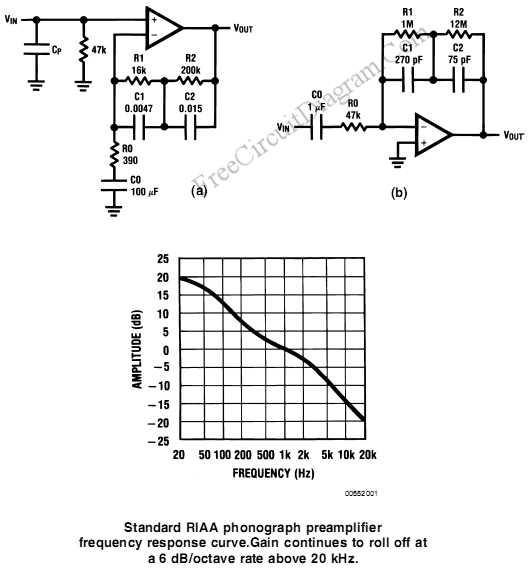
Recording Industry Association of Ameria (RIAA) has developed the recording standard of response curve for their recording. This curve is developed to optimize the gramophone recording response for lowest signal-to-noise ratio for gramophone technology. Because the tape recording response is not linear, the pre-amp for gramophone playback pickup should have such response that restore the original response, a flat response of played back signal. The schematic diagram of common RIAA pre-amp is shown in the figure below.
The op-amp used in the circuit is recommended using LM833, but any low noise op-amp will works. There are two types of the circuit in the figure. The first one is non-inverting, and the second one is inverting. In the non-inverting circuit, the 47k resistor shunting the input signal provide damping for the moving magnet phono cartridges. The input is also shunted by a capacitance equal to the sum of the input cable capacitance and Cp. This capacitance resonates with the inductance of the moving magnet cartridge around 15 kHz to 20 kHz to determine the frequency response of the transducer, so when a moving magnet pickup is used, Cp should be carefully chosen so that the total capacitance is equal to the recommended load capacitance for that particular cartridge. [Circuit's schematic diagram source: National Semiconductor Application Notes]
Possibly Related Articles:
- Two Stage Phono Pre-Amplifier with Very Accurate RIAA Response Curve
To produce a pre-amplifier with accurate RIAA response, this circuit use two stages of amplifier. This circuit is more complex than single op-amp RIAA pre-amp, but the performance is excellent... - Voltage-Current(V/I) Curve Tracer
Voltage-Current curve tracer is very important tools for components ant circuits troubleshooting. This circuit need an oscilloscope with X-Y inputs to display the curve. This circuit provide adjustment for both... - Low Pass Filter with Enhanced Step Response
Effect on the system’s time-domain response is a common problem when designing lowpass filters. The system may fail to recognize significant changes in time because pushing the cuttoff frequency lower... - DC Response Analog Data Recording using Audio System
If we want to record very low frequency or DC signal on an audio recording system, we have to convert the DC/low frequency signal into the spectrum of audible sound.... - Differential Pressure Transmitter Response – Video Tutorial
This is differential pressure transmitter response video. This video demonstrate the different of pressure transmitter response on low and high ports. The pressure transmitter is connected with the battery circuit... - Guitar Pre-Amplifier
This is simple circuit for Guitar Pre-Amplifier. This circuit has some advantages such as it will work under tough conditions, very simple and has high input impedance. This circuit will... - Hydrophone Pre-Amplifier
Hydrophone is similar with microphone, except that it is used in underwater environment. Off course a hydrophone can be used to pick up sound in air, but it will be... - Discrete 9-12V Microphone Pre-Amplifier
This is a microphone pre-amplifier circuit that use discrete components. The gain of this circuit is 100 and should be enough for most microphones. It is set by the ratio... - Feedback Amplifier Using Transistors
In designing small signal amplifier circuits, to achieve a specified amplifier gain we usually use opamp amplifier design to ease the setting of the gain. When the gain accuracy is... - Microphone Pre-Amplifier with Tone Control
Microphone can’t be directly connected to a power amplifier because the signal is too weak. Standard audio power amplifier accept about 1 Vrms to give a full volume (maximum power),... - Shunt Series Pair Wideband Amplifier
This is a Shunt Series Pair Wideband Amplifier circuit. This circuit has four feedback loops, they are two emitters feedback, shunt-shunt feedback and an AC feedback loop(series-shunt). This is a... - Battery Powered Electret Microphone Pre-Amplifier
Here is a schematic diagram of electret microphone pre-amplifier using LMV721 op-amp. because the LMV721 has low noise and low power features, it would be an ideal choice for battery...

|