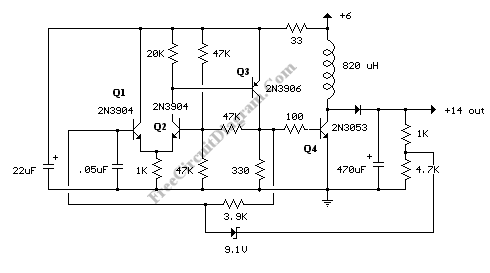
A DC-to-DC step-up converter is traditionally implemented using transformer, working by converting the DC voltage to AC Voltage, step-up it using transformer, then rectify and filter the transformer’s output to get a higher DC voltage. Using a switching method, we can step-up a voltage without a transformer. We just need an inductor which is driven by a switching transistor to boost the voltage. This circuit store the electric energy in an inductor before it is added to the input voltage, so this circuit is different than capacitor charge pump that store the electric energy using a capacitor.
The most interesting this is that circuit use a discrete components: no integrated chip is required, only few transistors with few passive components. Because the switching topology is a boost converter, this circuit cannot be operated as step-down regulator, so the output will always be higher than the input. The voltage output is depend on the load because the feedback mechanism, through the zener diode, will maintain the output at about 14 volt, regardless the voltage input variation and load current variation. The current from the voltage divider will flow through the zener diode if the output goes higher than the nominal value, and this condition will stop the oscillator built around the 2N3904 transistors. Stopping the oscillator will drop the output voltage and thus maintain the required voltage level at the output. This transistors (Q1, Q2, and Q3) form a Schmidt trigger that drive the final transistor Q4 (the switching transistor 2N3053).
This circuit is suitable for battery booster, if you need to run your 12 volt equipments on your old car that provide only a 6V supply from the battery. The output of this voltage doubler can be adjusted by changing the voltage divider, or for easier adjustment, you can replace the 4,7K resistor with a 5K potentiometer. Using a good inductor (low resistance), you can achieve up to 80% efficiency, and up to 2 Watt power can be delivered to the load. For the main diode, you can use a 3 Ampere Schottky diode 1N5822. [Circuit's schematic diagram source: Bill Bowden's circuit collection]
Possibly Related Articles:
- Transformerless, Switch Mode Boost Regulator, A Step-Up Converter
Using this switch mode regulator circuit, you can get a stable 12 volt output (500mA) although you just have 4,3 – 10V power supply. You can even boost a 3.5V... - Adjustable 1.5A Step Down 1.5 MHz Switching Regulator
Usually, when an high heating of the application environment is occurred due to the power dissipation, we use high current linear solution to solve that problem. But, we can solve... - LM2576 Switching Regulator
The circuits. To produce any output voltage, an external feedback resistors can be added. The sLM2576 is a Switching Regulator that can produce 15, 12, 5, 0r 3.3V output voltage... - Variable Power Supply Using Switching Regulator
If you are a hobbyist or a professional electronic engineer who make many electronic experiment, troubleshooting, or testing, providing wide range variable voltage power supply in your lab or workshop... - Stereo VU Booster Circuit using Transistors
This is a Stereo VU Booster circuit. In this circuit, shown in the schematic diagram, transistor FCS9014 is used. Actually you can use almost any type of small signal NPN... - 5V FET Voltage Regulator
This voltage regulator circuit gives a stable 5V output from unregulated inputs (more than 5V). The stability of the output voltage is good enough, only change less than 0.1 volts... - Discrete Voltage Regulator
It is still possible to build circuits without IC’s and still achieve a high level of performance while integrated circuits have become a staple of all modern circuit designs. A... - Direct High Voltage DC Regulator
This regulator circuit stabilize the output voltage at 200V directly (without a transformer). Although the output voltage is high, this circuit only suffer a tension of the voltage drop (Vinput-Voutput),... - Programmable Voltage Regulator Using L200 IC
This is a programmable voltage regulator circuit. With this circuit we can generate a voltage according to our wishes. This circuit uses L200 IC. Here is the circuit : Potentiometer... - Simple 555 Switching Circuit Provides Negative Supply from Single Positive Supply
If you need a negative supply for op-amp or just need negative bias voltage while operating from a single supply voltage (for battery operation for example), this circuit helps providing... - Automotive Voltage Regulator with Keep Alive Control
The LM9070 is a 5V, 3% accurate voltage regulator which have 250mA low-dropout. The regulator has an active low delayed reset output flag feature. This feature can be used to... - Low Drop-Out (LDO) Voltage Regulator Using Discrete Semiconductors
There are several integrated circuit chips designed specially for LDO (low drop out) voltage regulator. Building LDO using standard op-amp and discrete components can be an alternative. Here is one...

|