Crossover Calculator
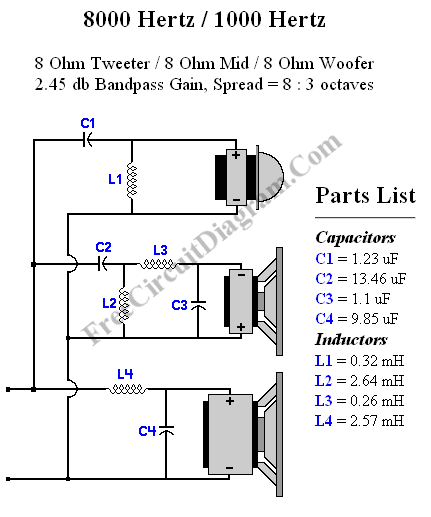
An online crossover calculator in this link is not only capable of designing 1st order crossover, but 2nd, 3rd, and 4th crossover calculation is also supported. Designing a 3 way crossover using the tool is very easy, you just need to fill the form to specify the design parameters: tweeter impedance, midrange impedance, and woover impedance, high crossover frequency, low crossover frequency, frequency spread, and the type or the order of the crossover design. Here are some examples of crossover design cases solved using the online crossover calculator:

Figure 1. Second Order 3 Way Crossover Design Solved Using Crossover Calculator
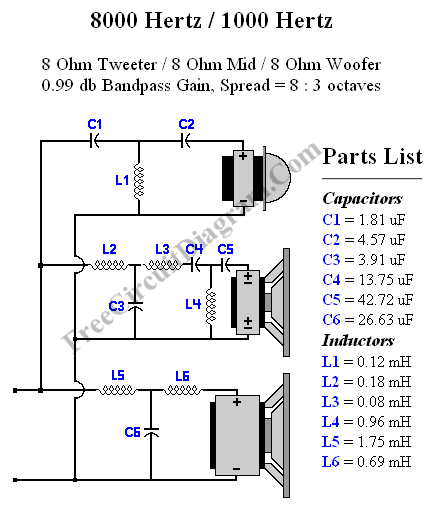
Figure 2. Third Order 3 Way Crossover Design Solved Using Crossover Calculator
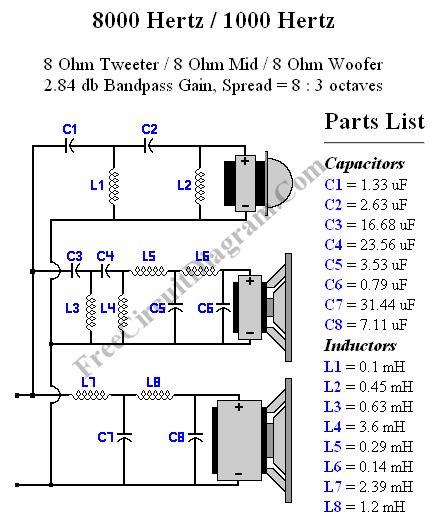
Figure 3. Fourth Order 3 Way Crossover Design Solved Using Crossover Calculator
You can see that the crossover calculator shows you not only the components values, but also the schematic diagram of the crossover design. [Source: Crossover Calculator ]
Possibly Related Articles:
- 1st-order-3-Way Crossover Circuit Design Using Free Online Tool
Designing passive crossover network for your speaker system is easy, just like what shown in our previous crossover design article, but now we can design many types of crossover even... - Passive Crossover Network Design for Hi-Fi Speaker
Crossover network for speaker can improve the quality of the sound, reducing the distortion level caused by excessive signal beyond the speaker’s frequency response. This articles describes how you can... - Bandpass Filter’s Gyrator Frequency Calculator
Gyrators are synthetic inductors, which are often used to form bandpass filters. As shown in the two examples here, the active buffering device can be a transistor or op-amp. This... - Active Crossover Circuit: Split The Audio Signal Before Amplification
You might be familiar with passive crossover network installed inside your speaker box, consist of inductors and capacitors. The problem with passive crossover network is that they dissipate the audio... - Differential Low-Pass Filter and The Design Formula
Multiple Feedback (MFB) is the best filter topology to use for differential low pass filters. Here’s the circuit diagram: To design this filter, a corner frequency is chosen based on... - Notch Filter: The Circuit’s Diagram and The Design Formula
Notch filter is known as band-cut filter or band-reject filter. The fuction of this filter is to remove some frequency portion of a signal. The schematic diagram of this filter... - First Order Low-Pass Active Filter: The Circuit Schematic Diagram and The Design Formula
The simple low-pass filter is shown in Figure below. The filter has a 20dB/decade roll-off after its corner frequency fc. Its low-pass frequency gain (f->0) is defined by R3/R1. This... - Dynamic Compressor, Self Powered Circuit Design
This dynamic compressor will give about 20dB compression, at very wide input signal range 100 mV to 10 V. Another advantage of this circuit is that this circuit doesn’t need... - Aviatrix Speaker Kit Crossover Assembly (I) – Video Tutorial
Below is video tutorial about how to assemble the crossover network for the TriTrix speaker system. The TriTrix speaker system uses a second order crossover. Second order mean thare are... - DIY TriTrix Destroyer Speaker Crossover Assembly – Video Tutorial
Below is video tutorial about how to assemble the crossover on the Aviatrix speaker. The speaker system has couple different version that you can build. There are mass loaded transmission... - SMPS Design: EMI Filtering – Video Tutorial
This is EMI Filtering video. This video explained us about EMI Filtering, EMI Filtering Element, and EMI Filtering Leakage Currents. In this video, conducted mode RFI limit is illustrated on... - SMPS Buck Converter Design (1 of 2) – Video Tutorial
Below is video tutorial about SMPS Buck Converter Design Example Part 1 of 2. Assume that Vin=12 V, Vout=5 V, Iload= 2A, Fsw=400KHz, D=Vin/Vout=0.416, Iripple=0.3 x Iload. Now we can...
|