Crystal Oscillator Using Transistor, Capable of Overtone Operation
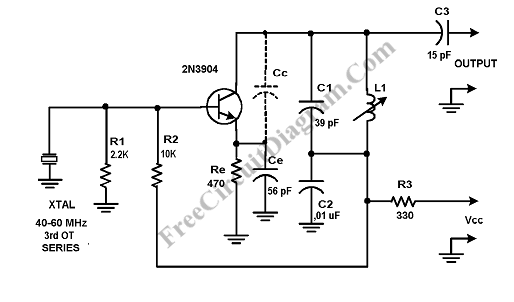
This circuit is a simple crystal oscillator that can be operated in overtone mode. Overtone mode permit the operation at higher frequency than specified by the crystal.
The circuit uses a grounded base amplifier configuration, and place the crystal as a series resonator. The transistor Q1 is biased in the active region as an amplifier. L1C1 is a resonant circuit placed in series with the collector. A small capacitor Ce is used to bypass the emitter resistor. Cc is the invisible internal capacitance between collector and emitter, and this cap provide feedback to the emitter, with the ratio is set by Cc and Ce. The base is effectively grounded at the resonant frequency of the crystal, and allow oscillation since the transistor now become a common base amplifier at this frequency. The power output is good (10-20 mW), as well as the efficiency, but the stability and the phase noise is not really good. The base circuit resistant in series with the crystal lower the Q factor of the resonator, and it degrades the stability and the phase consistency. While this is a major drawbacks, this characteristics give benefit of overtone operation capability, since the resonant frequency is not solely specified by the crystal. It’s possible to produce unwanted overtones oscillation by tuning L1 and C1 over a wide range. Stray capacitance across the crystal and its leads could also introduce uncontrolled spurious oscillation, and off frequency operation away from the true resonant frequency specified by the crystal. To make the desired frequency, the crystal should be ordered with a special offset frequency that can be determined by experiment. Adjusting or “pulling” the frequency can be done by tuning a series inductor or capacitor in the base circuit. A dead short my replace the crystal to allow the circuit works as a straight common base oscillator. The circuit is not recommended for the application that require a critical frequency and phase stability, but is OK for general purpose.