Simple Automatic Lead Acid Battery Charger
The Battery Charger Circuit
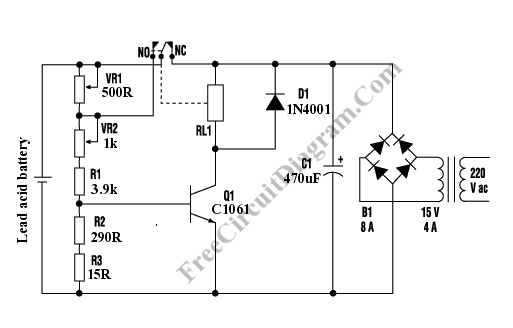
This lead acid battery charger circuit design is very simple and smart. I call it a smart battery charger design because it uses only few components to support many features. Here is the schematic diagram of the circuit:
This circuit is suitable for a general purpose lead acid battery charger, or for a charger modul that permanently connected to a battery within a power supply sub-system of your electronics system.
How This Battery Charger Works?
First, assume if the battery is empty and the mains supply is unplugged from the circuit. At this condition, the relay position will be in normal position. The transistor will be biased trough the VR1 path, and this will not activate the relay since the battery voltage is not high enough. Then if we connect the mains supply, a voltage will be generated by the transformer, rectified by the bridge diode, and flow to charge the battery. The voltage at this condition is still not enough to activate the transistor since the voltage from the transformer is like being shorted to ground by the empty battery. The battery voltage will get higher and higher as the time elapses, and at some point, the voltage Q1 base will be high enough to turn on the transistor, and activate the relay. After the relay is activated, the battery is disconnected from the transformer and now the transistor will be kept turned on by the battery voltage. You can also see if the biasing path for the transtor base is changed. Before the relay is activated, the path is a voltage divider consist of VR1-VR2-R1-R2-R3, and after the relay is activated, the voltage divider will be only VR2-R1-R2-R3. This mean that after the relay is activated to stop the charging process, the transistor is biased by a stronger voltage from the battery, making the voltage point to reactivate charging becomes lower than the point where the charging stops. This hysteresis behaviour is useful to prevent an unstable switching of the relay when the battery voltage falls slightly below the point where it stop charging. Without this hysteresis, after the relay is disconnected, although only for small amount, the battery voltage will falls immediately because the charging source is disconnected, and this will cause the relay to oscillate.