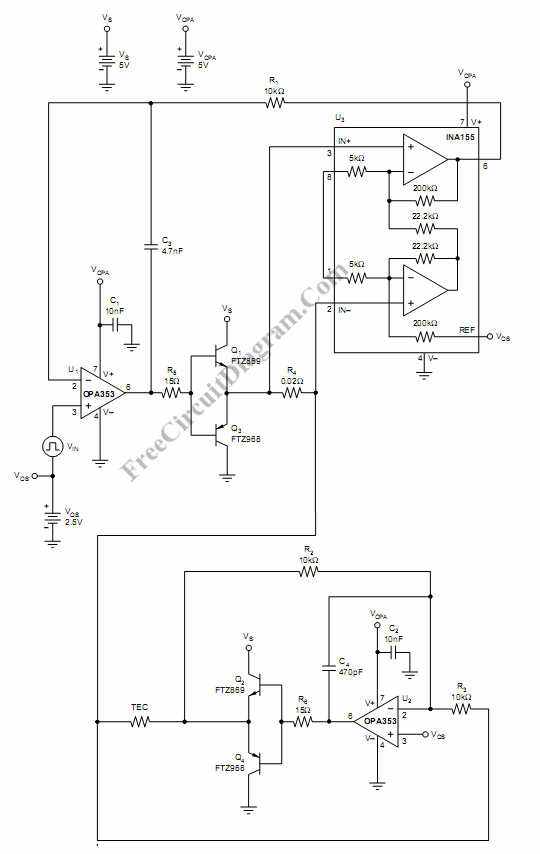
Thermoelectric cooler (TEC) or Peltier cooler is becoming popular because of its robustness and maintenance free characteristic. Here is one example of a linear thermoelectric cooler (TEC) driver circuit. This driver is capable of delivering ±2A into a TEC. This circuit operates on a single +5V supply and drives the TEC in the most preferred “constant-current” mode. Here is the schematic diagram of the circuit:

This TEC driver amplifier is a voltage-controlled current source. Constant current drive eliminates the effect of thermal “back EMF” on current through the TEC under dynamic temperature control conditions. Constant-current drive also assures that TEC drive current is independent of production variations in TEC junctions or long-term aging. [Schematic diagram source: Burr-Brown Products Application Report]
Possibly Related Articles:
- Circuit Converts PWM Fan Drive to Linear and Reduces Acoustic Noise
We usually use a fan to manage the temperature, but it produces audible noise at full speed. To reduce this noise we can use this circuit. The first circuit reduces... - Blackbox Sustain, An Audio Effect for Electric Guitar
Sustain effect in electric guitar is similar with compressor effect. The purpose of this effect is to make the note last longer when the string is plucked. The mechanism is... - Single Supply Octave Shifter: A Frequency Doubler Effect For Electric Guitar
Octave shifting or frequency doubling effect for electric guitar is done by rectifying the original signal, just like AC to DC conversion inside your AC-DC power supply adapter. The circuit... - Low-Drop-Out (LDO) Low-Voltage Linear Regulator Using NCP2860 IC
This low drop out (LDO) voltage regulator need only few components, with very low noise and very low drop-out voltage. The circuit illustrated in the schematic diagram below gives a... - PWM to Amplified and Buffered Linear Signal Converter
This is a simple circuit that can be used to convert a low-voltage PWM signal into a buffered and amplified linear output. This circuit is designed for fan speed control....
|