Closed Loop Motor Control

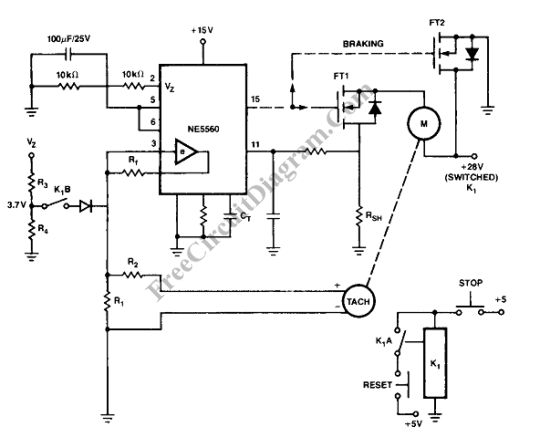
Closed loop (servo) control is used to make a constant speed motor control. Constant speed means that the speed of the motor will be kept constant although the load is change, or even when the electric supply voltage is also changed.  The circuit maintain the speed at a constant value by sensing the actual speed using a tachometer. If the speed is slowing down because of the load become harder, or because the electric supply get slightly lower, the circuit will automatically increase the power transfer to the motor by increasing the duty cycle of the motor drive, until the sensed speed by the tachometer and the reference speed has no difference.

constant speed pwm motor control circuit schematic

Motor Control Circuit

The circuit is unipolar, means that you cannot change the motor direction by the control signal. This switched mode motor drive (SMMD) uses NE5560 as the core of the circuit, suitable for small DC motor. The power switching component is a single Philips BUK456-100A Power MOSFET. It has current handling capability  over 30 A, and 100 V voltage rating of VDS, and 0.057 Ohms RDS-ON. The nominal frequency of the PWM is 10 KHz, but much higher frequency is possible. It is also a good idea to operate the switching over 20 KHz to avoid audible interference to audio equipments. VGS, the peak gate to source voltage,  is 15V to ensure minimum RDS(ON), so the power loss in the PowerMOS switch is minimum.

Torque Limiter

This circuit include a current sense resistor, placed in the source lead to monitor motor drive current on a cycle-by-cycle basis.This resistor value is set to produce the error amplifier threshold voltage at the desired maximum current. When this threshold voltage is exceeded, the NE5560 then automatically limits the duty cycle of the PWM output. You can say this is a torque limitter feature, which is actually an unavoidable effect of the switching device protection by limiting the current.

Motor Start-Up and Dynamic Braking

At power on,  to avoid power surge, a slow start network (Pins 2,5,6) gradually ramps up the duty cycle. Forcing the input of the error amplifier By K1B produce a fixed duty cycle control for braking. The over-current circuit still work during braking. [Circuit schematic diagram source: Power Semiconductor Applications from Philips Semiconductors]


Possibly Related Articles:

  • Closed-Loop Automatic Power Control for RF Applications
    This is a circuit of Closed-Loop Automatic Power Control for RF Applications. The circuit uses a log detector (AD8318) and a VGA (ADL5330). This circuit has a high temperature stability...
  • Closed Loop PWM PC Fan Controller – Video Tutorial
    Below is video tutorial about closed loop PWM PC fan controller. Unlike the other controller, in this circuit the potentiometer would not directly changes the duty cycle instead it set...
  • Open Loop DC Motor PWM Controller Using NE5560
    This is a circuit of the open loop PWM controller using the NE5560. This controller is suitable for Switched mode motor drive. To get the best dynamic response, the switched-mode...
  • Stepper Motor Controller
    Stepper motor gives a simple, low cost, and accurate position control. Stepper motor can be driven by circuit mounted close to the motor, and controlled by a remote control circuit...
  • PWM Motor Control Circuit
    Speed control for dc motor (electric motor) can be implemented using open loop or closed loop. Closed loop controller, also known as servo controller,  or a feedback control, gives the...
  • OP90 4 mA to 20 mA Current Loop Transmitter
    An output of 4 mA to 20 mA that is linearly proportional to the input voltage is provided by the current transmitter on figure below. Line rejection is 0.0005%/volt and...
  • Permanent Magnet Motor Control with SCR
    This is a schematic diagram of Permanent Magnet Motor Control circuit. This circuit is used to control the permanent magnet control. This circuit uses alternistor triac to enhance commutation characteristics...
  • 555 IC PWM Motor Control with Current Limiter
    To provide rapid motor speed changes and motor direction reversal, four outputs drive a MOSFET H-bridge. N-channel devices are the lower rail power MOSFETs and P-channels are the upper MOSFETs....
  • Servo Motor System Controller
    This is a Servo System Controller circuit. This circuit is used to control a servo motor remotely. This circuit uses the 555 and requires only six extra components. Here is...
  • 3 Phase AC Motor Speed Control
    Controlling the speed of three phase ac motor is done by controlling the frequency of the power line supply,  since the motor is synchronized with the line frequency. Three phase...
  • Simple Stepper Motor Controller
    Stepper motor controller is needed to run a stepper motor, since a stepper motor cannot work by just connecting it to a power supply.  To program a stepper motor to...
  • Small DC Motor Speed Controller
    Electric motor has been widely used as motion control, and many  type of motor controllers  have been designed to provide variable speed drives for the motor. The best controller is...