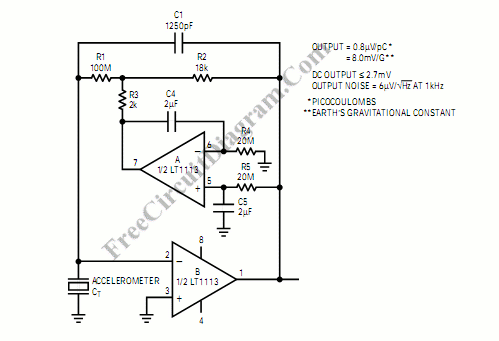
Precision accelerometers needs inverting mode amplifier since they are usually charge-output devices. This amplifier convert charges into voltage output. The circuit below is an example of accelerometer with DC servo.

The charge from the transducer is converted to a voltage by C1, which should equal the transducer capacitance plus the input capacitance of the op amp. The low frequency bandwidth of the amplifier will depend on the value of R1 • C1 (or R1 (1 + R2/R3) for a Tee network). The noise gain will be 1 + C1/CT. The time constant of the servo (1/R5C5) should be larger than the time constant of the amplifier (1/R1C1). [Schematic diagram source: Linear Technology Application Notes]
Possibly Related Articles:
- Hydrophone Pre-Amplifier
Hydrophone is similar with microphone, except that it is used in underwater environment. Off course a hydrophone can be used to pick up sound in air, but it will be... - Digitally Controlled Dual Polarity Amplifier
This schematic diagram below shows a Digitally Controlled Dual Polarity Amplifier circuit. The circuit (a) can give a means of amplifying a signal either in non inverting and inverting mode.... - Signal Conditioning Amplifier for Piezofilm Sensor
The signal can be converted by piezoelectric films in many ways such as thermal to electrical (temperature sensor), mechanical to electrical (microphone), and electrical to mechanical ( a loudspeaker). The... - 10.7-MHz IF amplifier
This is 10.7-MHz IF amplifier circuit. This circuit is used in many application such as cell phone base station receivers (final IF) and FM broadcast receivers. The ceramic filter that... - Guitar Pre-Amplifier
This is simple circuit for Guitar Pre-Amplifier. This circuit has some advantages such as it will work under tough conditions, very simple and has high input impedance. This circuit will...
|