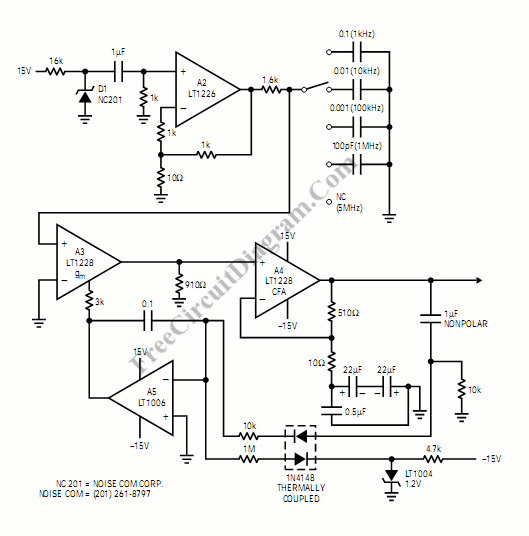
Random noise source is often needed in testing many type of electronic systems such as filter, audio, or RF communication. The circuit presented here generates an RMS amplitude regulated noise source with selectable bandwidth. With 1 KHz to 5 MHz decade ranges selectable bandwidth and 300mV RMS output, this noise generator is suitable for wide range of application.

Noise is generated by D1 that is AC coupled to A2, an amplifier with broadband gain 100. The output of A2 is fed to a simple selectable low-pass filter. The filter’s output is applied to LT1228 operational transconductance amplifier A3. A3’s output feeds current feedback amplifier LT1228 A4. A4’s output, which is also the circuit’s output, is sampled by the A5-based gain control configuration. This closes a gain control loop to A3. A3’s ISET current controls gain, allowing overall output level control. [Schematic diagram source: Linear Technology Application Notes]
Possibly Related Articles:
- Low Cost Noise Generator
White noise is a random signal (or process) with a flat power spectral density. In other words, the signal contains equal power within a fixed bandwidth at any center frequency.... - Pink (Flicker) Noise Generator
The circuit's schematic diagram shown in the figure below is a flicker noise generator, an implementation of flicker noise analog modeling presented in NBS technical note #604, "Efficient Numerical and... - Low Noise Audio Line driver
LT1206 has been naturally selected as the components for video application since it has suitable bandwidth and output derive capability. This high performance features is not only suitable for video... - Hum Filter, An Ultimate Weapon To Remove AC Line Noise
You might think that hum noise is produced by electronic device with improper design, yes you're right. And you might choose to solve the trouble maker, the source. You begin... - LM1894: Single Chip Dynamic Noise Reduction System (DNR)
The LM1894 is a stereo noise reduction circuit suitable for audio playback application. The DNR system is non-complementary, meaning that it does not require encoded source signal. The system is...
|