Sponsored Links

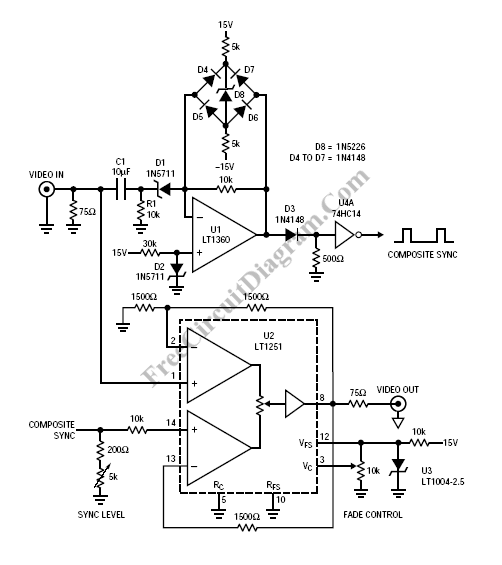
Fading a video signal is not as simple as attenuating the whole signal, since there will be a point where the sync amplitude becomes too small.  Not only the fading effect, but you’ll get also a rolling and tearing picture if you do this.  One solution for this can be as complex as running a separate sync signal into the monitor, but this is not a low cost solution.

video fader circuit schematic

Here we present a simple video “volume control”, that fade the picture to black while maintaining a good video fidelity.  LT1360 (U1) and its associated components form an elementary sync separator.  R1, D1 and C1 clamp the composite video signal.  To compensate for the drop across D1, D2 is employed to bias the input of U1. The sync information that occupy the most negative portion is amplified by U1 when D1 conducts. In the feedback network of U1, the clamp circuit (D4 to D8) prevents the amplifier from saturating. The shape of the sync waveform is  improved by D3 and CMOS inverter U4.

Most of video signals will works with this circuit, except for very noisy or distorted signals. The rest circuit is an LT1251 video fader (U2) configured to fade the signal ranging from the original level to black level.  [Circuit schematic diagram source: Linear Technology Application Notes]


Possibly Related Articles:

  • Video Wire: Enable Video Transmission Via Long Cables
    This circuit enables you to connect your camera with very long wire. The circuit is actually a video amplifiers. At the sender part, the amplifier is used to make a...
  • Video Switch
    As the price of security camera going down, installing the camera in the shop, office, or even in home becomes economically feasible. Providing a dedicated monitor for every installed camera...
  • FET Cascode Video Amplifier
    This is a simple  FET Cascode Video Amplifier circuit. This circuit has some features, they are reduction of feedback to almost zero and very low input loading. Here is the...
  • Video Line Driver
    LT1206 is suitable for driving multiple video cables since it has 60MHz bandwidth, 250mA output current capability, and low output impedance. Please keep in mind about unterminated line effect when...
  • Twisted-Pair Video Cable Driver and Receiver
    Twisted-pair wiring is a wiring technique that usually used for in-building data communication. Compared to conventional coaxial-cable, this technique offers substantial cost saving, for video transmission on the same medium....