This is a simple sawtooth generator circuit. The advantages of this circuit are low cost and produces an auxiliary square wave at the same frequency. This circuit can be used to sweep the frequency of another generator. Here is the circuit :
High Performance Sawtooth Generator
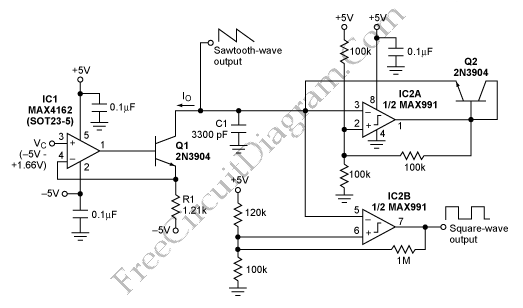
A voltage-controlled current source is formed by IC1 with R1 and Q1. The C1 is discharged by current Io until it’s voltage is less than 1.66V. It will swing its output to 5V and trips the IC2A comparator. The C1 is charged by current through the diode-connected transistor (Q2) until its voltage reaches 3.33V, so the IC2A output to swing back to ground. The output frequency is determined by :

fOUT = (3(5V +VC)/5V)(1/R1C1).

We can set the fOUT as high as desired by adjusting the values of C1and R1, subject to the limitations of comparator IC2A’s slew settling and rate time. The frequency range over which it can operate determined by generator’s linearity. [Source: maxim-ic.com]


Possibly Related Articles:

  • High Frequency Waveform Generator
    Waveform generator is very useful in electronic experiment and design. This circuit generate sine wave oscillation, but actually we can modify the circuit to generate triangle or square wave function....
  • Programmable Levels High Speed Pulse Generator
    This is a Programmable Levels High Speed Pulse Generator circuit. This circuit consist of Lilliputian dimensions associated with the sub-micron geometries of many analog and most digital processes also advanced...
  • Sawtooth Wave Oscillator
    Sawtooth wave oscillator is used in cathode ray tube deflection circuitry, in a PWM modulator, or in a analog to digital conversion. You can also use it in your own...
  • Sawtooth Wave Oscillator Using 555 IC
    Sawtooth wave oscillator  circuit can be implemented using several methods, here we present one design that employs 555 IC.  Here is the schematic diagram of the circuit: The core of...
  • Variable Frequency Sinewave Generator
    This sine wave generator is adjustable between 15 Hz to 150 kHz. The circuit is basically a Wien-bridge oscillator, with multiple capacitor selection. Here is the schematic diagram: A stereo...