The most used is single-phase induction motors. This motors operate with a single phase power supply, only have one stator winding and are also squirrel cage. The motor is not self-started when connected to power supply because of the single phase. The motor only vibrate and not rotate because the necessary torque is not generated.

Single Phase Induction Motor Control Theory circuit schematic
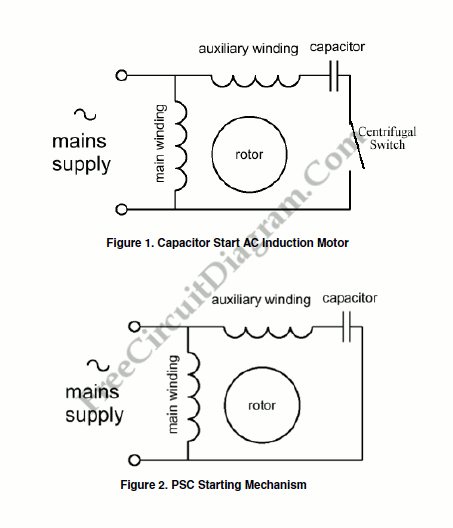
Most single phase motors have a main and auxiliary winding to provide the starting torque, both in quadrature to help generate the phase-shifted magnetic field.

The auxiliary winding current from the main winding is phase-shifted. The motor will start rotate when the capacitor is connecting in series with the auxiliary winding. We can disconnect the capacitor and the auxiliary winding at 75% of the motor nominal speed using a centrifugal switch. We use this topology if high torque is required. The capacitor and the auxiliary winding remain connected in most fan motors. This configuration is called permanent split capacitor (PSC) AC induction motor. Considered to be the most reliable single phase motors, no centrifugal switch is used. They can be designed for optimum efficiency and high power factor (PF) at rated load. [Circuit's schematic diagram source: Freescale Semiconductor Application Note]


Possibly Related Articles:

  • Enabling 3 Phase Motor to Operates with Single Phase Supply
    Capacitor have been use for decades to operate 3-phase motors on single-phase power. Two single-phase wires are connected to two of the inputs on a 3 phase motor on this...
  • Synchronized TRIAC for Small Induction Motor Speed Control
    We can use this circuit diagram to adjust the speed of a low-power induction motor, such as those which can be found in fan application. The function of capacitors C1,...
  • 3 Phase to Single Phase Rotary Converter
    In the circuit the rotary converter is nothing more than a second motor which is acting as a generator. The tools motor performed this function with the static converter, but...
  • 3 Phase AC Motor Speed Control
    Controlling the speed of three phase ac motor is done by controlling the frequency of the power line supply,  since the motor is synchronized with the line frequency. Three phase...
  • 2 Phase and 3 Phase Motor Drivers
    The schematic diagram below show 2-phase and 3-phase motor driver circuits. This circuit can used to drive an AC motor because this circuit has an integrated power operational amplifier, built-in...
  • Complement Phase Inverter with Single Transistor
    This is a complement phase inverter circuit. Sometimes this circuit called a paraphase amplifier circuit. This circuit has two output signals that is have sufficient “headroom” because this circuit is...
  • Phase Control Circuit
    A phase control circuit can be used to control the power delivered to an AC load. The phase control circuit control the AC waveform, cutting the cycle to give full...
  • Stepper Motor Controller
    Stepper motor gives a simple, low cost, and accurate position control. Stepper motor can be driven by circuit mounted close to the motor, and controlled by a remote control circuit...
  • PWM Motor Control Circuit
    Speed control for dc motor (electric motor) can be implemented using open loop or closed loop. Closed loop controller, also known as servo controller,  or a feedback control, gives the...
  • Permanent Magnet Motor Control with SCR
    This is a schematic diagram of Permanent Magnet Motor Control circuit. This circuit is used to control the permanent magnet control. This circuit uses alternistor triac to enhance commutation characteristics...
  • Servo Motor System Controller
    This is a Servo System Controller circuit. This circuit is used to control a servo motor remotely. This circuit uses the 555 and requires only six extra components. Here is...
  • Simple Stepper Motor Controller
    Stepper motor controller is needed to run a stepper motor, since a stepper motor cannot work by just connecting it to a power supply.  To program a stepper motor to...