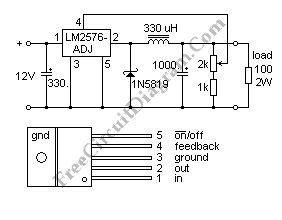
The circuits. To produce any output voltage, an external feedback resistors can be added. The sLM2576 is a Switching Regulator that can produce 15, 12, 5, 0r 3.3V output voltage from maximum supply voltage of 60V or 40V. This LM2476 featured with voltage reference, switch and feedback path for use in either the negative boost or the buck saturation voltage of The LM2576 switch is typically 1.4V. A heatsink may be needed to solve the power dissipation, however the thermal dissipation is internally limited. The LM2576 has quiescent current of 50 µA in standby (on/off high). This circuit is a testing circuit for LM276. Here is the schematic diagram of the circuit:

The electrolytic capacitors at output and input should be connected with leads as close as possible. The power dissipation must be small because the load is 100R, so the heat sink is not needed. The capacitor’s voltage must higher than the voltages used in the experiment. This circuit uses 40V, 1A Schottky diode or the 40V, 3A 1N5822 for heavier currents.
Possibly Related Articles:
- Variable Power Supply Using Switching Regulator
If you are a hobbyist or a professional electronic engineer who make many electronic experiment, troubleshooting, or testing, providing wide range variable voltage power supply in your lab or workshop... - Transformerless Voltage Booster Circuit: A DC-DC Step-Up Switching Regulator Using Transistors
A DC-to-DC step-up converter is traditionally implemented using transformer, working by converting the DC voltage to AC Voltage, step-up it using transformer, then rectify and filter the transformer’s output to ... - Adjustable 1.5A Step Down 1.5 MHz Switching Regulator
Usually, when an high heating of the application environment is occurred due to the power dissipation, we use high current linear solution to solve that problem. But, we can solve... - How to Easily Design a Complex Switching Regulator – Video Tutorial
Below is video tutorial about how to design a complex switching regulator as simple as a linear regulator – Linear Technology. Linear regulator is very simple. Linear regulator circuit has... - Variable Frequency Switch Mode Regulator
This voltage regulator circuit operates in switch mode. Using the configuration shown in the schematic diagram, this circuit has variable switching frequency, depends on the input voltage and load condition.... - Simple 555 Switching Circuit Provides Negative Supply from Single Positive Supply
If you need a negative supply for op-amp or just need negative bias voltage while operating from a single supply voltage (for battery operation for example), this circuit helps providing... - High Side Current Sensing for Low Side Switching
An AD8205 can be used to make a high-side current sense with a low side switch. Besides AD8205, an inductive load (solenoid) and a resistive shunt are added in this... - High Side Current Sensing for High Side Switching
Sometimes, there are unexpected solenoid and excessive corrosion occurs on current sense circuit. Corrosive effects can be occurred because of the differential voltage between the ground and the load. To... - 5V FET Voltage Regulator
This voltage regulator circuit gives a stable 5V output from unregulated inputs (more than 5V). The stability of the output voltage is good enough, only change less than 0.1 volts... - Discrete Voltage Regulator
It is still possible to build circuits without IC’s and still achieve a high level of performance while integrated circuits have become a staple of all modern circuit designs. A... - Adjustable Shunt Regulator
This shunt regulator acts like a Zener diode, but we can adjust the voltage (via a potentiometer). Here is the schematic diagram of the circuit: When the maximum load current... - Direct High Voltage DC Regulator
This regulator circuit stabilize the output voltage at 200V directly (without a transformer). Although the output voltage is high, this circuit only suffer a tension of the voltage drop (Vinput-Voutput),...
|