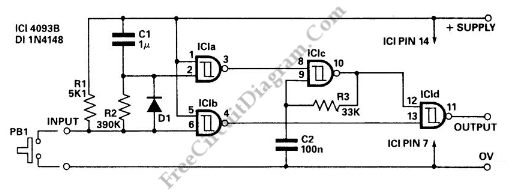
This circuit is a Delayed Pulse Generator that is used to provide pulse rate and independent control of initial delay. The pulse generator of this circuit is IC1c which the operation is depended on  the normally low O/P of the IC1a. The PB1 is used to make the circuit input goes low. When PB1 is pressed, IC1b O/P goes high and the circuit O/P goes low thus replicating the input. Here is the schematic diagram of the  circuit:

Delayed Pulse Generator circuit schematic

The point where IC1a O/P goes low is charged by capacitor C1 via R2. This action will cause pulse generator IClc to start and “rapid fire” pulses appear at the circuit O/P. C1 will discharged rapidly via R1 and D1 when the circuit input returns to the high state. The pulse rate is controlled by C2 and R3 while C1 and R2 control the initial delay. Using the shown values, the pulse rate of this circuit is 200/300Hz and delay of 0.5 seconds depending on supply voltage. PB1 can be replaced by a common emitter transistor stage or an open collector TTL gate. [Circuit's schematic diagram source: seekic.com]


Possibly Related Articles:

  • TC9400 Wide Frequency Range Pulse Generator
    The reason why TC9400 V/F converter is very useful in the laboratory are because it’s portable, battery-operated, and low cost frequency source. Both pulse and square-wave outputs are provided by...
  • Pulse Generator (Oscillator) With Adjustable On-Off Period Using CA3130 Op-Amp
    One of the interesting features of CA3130 op-amp  is its high input resistance, because using such high  input resistance, we can build an astable multivibrator with high R/C ratios. The...
  • Programmable Levels High Speed Pulse Generator
    This is a Programmable Levels High Speed Pulse Generator circuit. This circuit consist of Lilliputian dimensions associated with the sub-micron geometries of many analog and most digital processes also advanced...
  • LT1016 – LS74121 Voltage Controlled Pulse Width Generator/ Monostable Multivibrator
    Monostable multivibrator poduces a fixed pulse width when receiving a trigger signal on its input. The pulse width of the output is fixed regardless of the input pulse duration/width. In...
  • Missing Pulse Detector Circuit with 555 IC
    Missing pulse detector will receive a source of repetitive pulse in normal condition. The output of this detector circuit will be inactive for normal condition (output pin 3 of  555 ...
  • Pulse Width to Analog Voltage Demodulator
    This is a schematic diagram of a pulse width to analog demodulator circuit. This circuit is used to demodulate the pulse width to analog voltage level. With input pulse width...
  • Triangular-Wave Generator
    The circuit diagram below shows a constant amplitude triangular-wave generator. A variable frequency triangular wave whose amplitude is independent of frequency is provided by this circuit. As a reset circuit,...
  • Phase Delay Network for 3D Audio Enhancement
    3D enhancement is needed to create a fully 3-dimensional sound for most stereo multimedia products. Usually, simple phase-delay circuits is used to produce a widening effect on the perceived sound...
  • Stable 60 Hz Frequency Signal Generator
    A 60Hz signal generator can be useful in testing your circuits. You can test your notch filter, simulating hum noise, or you can use it as part of your DC-to-AC...
  • High Performance Sawtooth Generator
    This is a simple sawtooth generator circuit. The advantages of this circuit are low cost and produces an auxiliary square wave at the same frequency. This circuit can be used...
  • Variable Frequency Sinewave Generator
    This sine wave generator is adjustable between 15 Hz to 150 kHz. The circuit is basically a Wien-bridge oscillator, with multiple capacitor selection. Here is the schematic diagram: A stereo...
  • High Frequency Waveform Generator
    Waveform generator is very useful in electronic experiment and design. This circuit generate sine wave oscillation, but actually we can modify the circuit to generate triangle or square wave function....