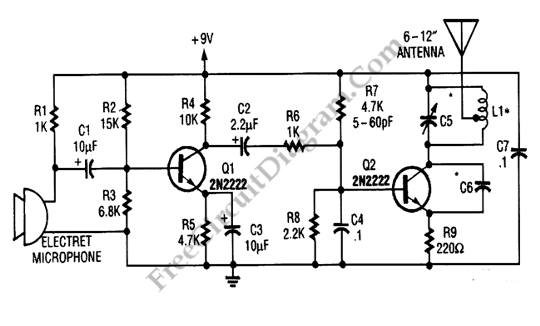
This FM transmitter circuit can be used as a wireless microphone, can be received by an ordinary 88- to 108-MHz FM broadcast receiver. For the power supply, this transmitter circuit is powered by a 9 V battery. To comply with the radiation limit of FCC rules, keep the antenna length under 12 inches. L1 is 6 turns of #24 wire wound around a pencil or a 1/4″ form, with turns spacing of 1 wire diameter. C6 is a gimmick capacitor which has value about 1 pF.
[Circuit's schematic diagram source: seekic.com]
Possibly Related Articles:
- Two Transistors Wireless Microphone (FM Transmitter)
Please be warned if operating this circuit might violate the regulation of your country, because this FM transmitter circuit radiate strong radio frequency to the environment. This wireless microphone is... - Single Transistor Wireless Microphone (FM Transmitter)
This wireless microphone circuit uses only a single transistor, with few additional passive components. This FM transmitter is very compact and need only a single cell 1.5Volt battery, even works... - FM Transmitter Using Logic Gates
This is a FM Transmitter circuit. This circuit uses logic gates. This transmitter circuit has a RF oscillator. This oscillator uses 10.7Mhz ceramic filter and inverter N2 to drive the... - Another Small Single Chip FM Transmitter
This FM transmitter circuit is small, similar to our previous single chip FM transmitter, but this FM transmitter is monophonic. You can see in the circuit’s schematic, the left and... - Single Chip Stereo FM Transmitter Circuit: A Very Compact Design
ROHM (www.rohm.com) is originally a resistor producer company, but finally expand their business and produce monolithic IC, and this one used in our circuit is the example. The internal structure... - Development Kit for Wireless Sensor – Video Tutorial
The wireless technology is developed well today’s. This video is about the wireless sensor development kit. This video explains the wireless sensor from jennic, jennic 5139. This module include microcontroller,... - Low Noise Microphone Pre-Amp with Op-Amp
Microphone pre-amp is a very simple circuit, most all low noise op-amp will be sufficient for this circuit (TL071, TL082, OPA371, NE5534, etc). This circuit will be suitable for dynamic... - How Condenser Microphone Works
A condenser microphone is different from dynamic microphone. The condenser microphone, the diaphragm is assembled close to a rigid backplate. This microphone need a battery that is connected to the... - How Dynamic Microphone Works
A dynamic microphone is an example of dynamic transducer. The principle of dynamic transducer is a movement of a thin metallic diaphragm because of sound wave. This diaphragm attach coil... - Discrete 9-12V Microphone Pre-Amplifier
This is a microphone pre-amplifier circuit that use discrete components. The gain of this circuit is 100 and should be enough for most microphones. It is set by the ratio... - Microphone Pre-Amplifier with Tone Control
Microphone can’t be directly connected to a power amplifier because the signal is too weak. Standard audio power amplifier accept about 1 Vrms to give a full volume (maximum power),... - LM10 Single-Cell Microphone Amplifier
This is a Single-cell microphone amplifier circuit. This circuit produce a voltage gain of 60 dB at 500Ω load with bandwidth 5kHz. This circuit can provide a 60dB gain up...
|