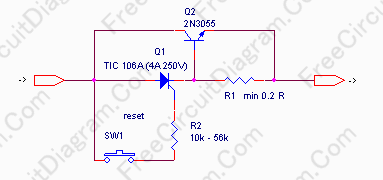
Tired replacing your power supply fuses, or it cost too much because too often to blow? Use this electronic fuse and your life would be easier. It is good for your new power supply design, or you can just add it to your old power supply unit. This fuse has real fast response because it works based on solid state device, a thyristor. No need to wait something to get hot and melt, the thyristor almost done the job before your milisecond timer counting up.
The resistor R2 should be chosen as 1k? per Volt of source voltage, for example 12k? for 12 volt supply, or 33k? for 33 volt source. The R1 resistor should be chosen to set the current point which should be cut on overload condition. The current breaking mechanism is done when the voltage across R1 exceed the bias voltage of Q2, and it’s about 0.7 volt. When this voltage point is exceeded, the Q2 transistor will turn on and and the current flow through the thyristor Q1 will fall below a level needed to maintain the thyristor latching. Therefore the thyristor will cut the current, and now the transistor Q2 also stops conducting because the base voltage (the voltage across R1) now disappear. After a current shorts and this electronic fuse cut the power supply, If everything is OK then you can get back to normal operation by pressing the reset switch SW1 to turn on the Thyristor again.
Possibly Related Articles:
- In-Circuit Automotive Fuse Tester
This is a schematic diagram of auto fuse monitor circuit. This circuit is very useful for automobile application, checking a live fuse without wasting any electrical power if the fuse... - How to Solder Electronic Circuit – Video Tutorial
How to solder a resistor to PCB is presented in this video tutorial, get expert tips and advice from an expert on how to solder electronic equipment in this free... - How to Build Electronic Circuit – Video Tutorial
Building electronic circuit tutorial (DIY: do it yourself project) is presented in this video. You can learn the basics about schematics and how they are used in electronics in this... - Circuit Breaker
We can use a circuit breakers to limit the current in a single circuit in most household applications. Although breakers come in many sizes, typically a single circuit is limited... - Electronic Metronome
Metronome is very important tool if you studying music playing. There are mechanical metronome device in the past, but today, electronic metronome is much more popular since it can be... - L6569 Electronic Ballast
This is a electronic ballast circuit using L6569. This circuit uses The L6569 because it can control a low voltage halogen lamp transformer or a symmetric half bridge inverter of... - How to Make Electronic Stethoscope – Video Tutorial
Below is video tutorial about how to make a device to hear through the wall. or called Spy Stethoscope. To make this device we only need a stethoscope and multimedia... - Electronic Metronome Emulates Mechanical Sound
It would be cool and elegant to a have mechanical sound character for our electronic metronome. This electronic metronome circuit will produce such sound, making your life more fun. Here... - How Electron Flows in Electronic Circuits – Video Tutorial
This is electron flow video tutorial. This video shows how electron flow occurs in electronics. All basic electronic start with a great water analogy. The garden hose represent a piece... - IR2156 Electronic Ballast for CFL (Compact Fluorescent Lamp)
This is Electronic Ballast for CFL (Compact Fluorescent Lamp) circuit using IR2156. The IR2156 contains a high voltage half-bridge gate driver with a state diagram and programmable oscillator to make... - Variable (Adjustable) Current Limiter Circuit
This circuit provide automatic current limiting up to 8.4A. Unlike current limiter that uses only a resistor, this current limiting circuit doesn’t drop the voltage, or at least keep the... - Typical Flyback Circuit
Diagram below show the typical flyback. This flyback mostly found in a direct view color television or computer monitor. The right side show us the high voltage section. This section...

|