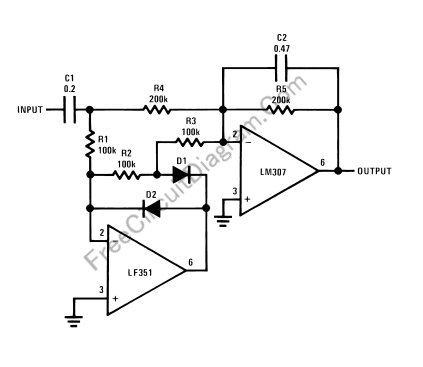
This circuit is similar to peak detector, but the the output won’t immediatelly follow the input peaking. Because the output follow the input peak slowly, averaging effect will be seen at the output. In the figure below you can see the circuit’s schematic diagram.
Use 1% resistor for R1, R2, R3, and R4, and you can achieve negative and positive cycle difference of 0.5dB at the worst case. If you use 5% resistors then the difference between positive and negative cycle gain difference would be about 2dB (worst case). The averaging time constant will depend on R5-C2, you can change to other values if needed. [Circuit's schematic diagram source: National Semiconductor Application Notes]
Possibly Related Articles:
- Precision Half-Wave Peak Detector
A simple half-wave peak detector using a single transistor is very compact and low cost, but if the application require precise detection for signal under 100mV then that circuit become... - Positive and Negative Peak Detector Circuit Using CA3130 Op-Amp
Implementing peak-detector circuits is very easy with the CA3130, as shown in schematic diagram of this circuit. The figure below shows the schematic diagram of the peak detector circuit. The... - Single Transistor Half-Wave Peak Detector Circuit
Using only a single transistor and few passive components, you can build a fairly sensitive peak detector. circuit This peak detector circuit is suitable for audio application, since the average... - Precision Full-Wave Peak Detector: Detect The Envelope of An Audio Signal
This circuit detect the amplitude of audio signal, suitable for audio level detection that demand for high precision. Amplitude detection or signal envelope detection is usually implemented using a peak... - Single Supply Zero Crossing Detector
Zero crossing detector is used to convert sine wave or other signal into square-wave, the output should be low if the input is negative and high if the input if...


| DESIGN BY