LED Audio Level (VU) Indicator and Alarm: The Dot Turns to Bar When The Signal Reach The Maximum Level!
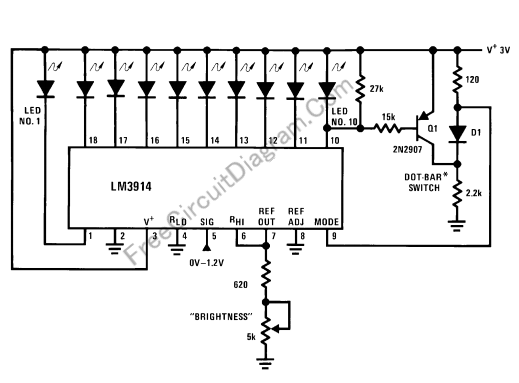
This LED (Light Emitiing Diode) display consist of 10 LEDs to indicate the level of an input signal. If the signal is small, only LED#1 will light, and if the signal level getting higher then you’ll se the light dot will move through LED #2, #3, #4, … and so on. When the signal input drive the dot until LED #9 lights, the next increasing input signal won’t only move the dot to LED #10, but it turn on all the LEDs, changing the dot to a full-scale bar. This give you a better alarm to show you that the maximum level has been reached.
The Circuit’s Schematic Diagram
The input signal is detected by the chip at pin 5, and it should range between 0-1.2V. This range is suitable for standard audio line (line-out) level. This circuit uses LM3914 which has linear scaling for the LED, the indication move linearly with the input signal: if the input is maximum then the LED#10 will light (and all other LED’s because the alarm fuction is working), if the input is at half maximum then the LED#5 or #6 will light, LED #1 will light when the signal is 1/10 of the maximum.
Signal Conditioning for The Input Signal
To show well defined dot position representing audio level (VU, voltage unit) as we percept, we need to feed this circuit using the output of a peak detector. Connecting directly to audio signal would give fast blinking display with vague dot position, since audio signal is actually oscillate between an equilibrium point. The single transistor peak detector is suitable for this purpose, because the resolution of two adjacent LEDs is slightly more than 100mV.
Logarithmic Scale Display
Logarithmic display give more representative indication when dealing with audio signal, since we naturally percept the sound level in logarithmic manner, a change from 9 to 10 is not really noticed as the change from 1 to 2 in sound wave amplitude. We percept the first one as being almost no change while the last one is twice louder, although both cases show the same one absolute unit change.
For the logarithmic scale, National Semiconductor provide other series, with pin-to-pin compatible with LM3914, and it’s LM3915. Just change the chip with LM3915 and the display will be in logarithmic scale. But wait, you need more precise peak detector for logarithmic scale, since the display will have more precise resolution at low level indication. The precision half-wave peak detector would be suitable for this circuit. Using logarithmic scale indicator, you’ll notice good dynamic indication in almost all level of your volume control. [Circuit schematic diagram source: National Semiconductor Application Notes]