Single Chip Single Supply Instrumentation Amplifier
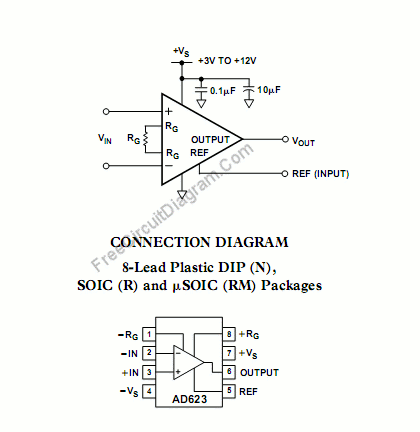
The AD623 is a single chip instrumentation amplifier. The internal circuit is based on a modified classic three op amp approach to assure single or dual supply operation even at common-mode voltages at the negative supply rail. Some key features are: Low voltage offsets, input and output, as well as absolute gain accuracy, and one external resistor to set the gain, make the AD623 one of the most compact and robust instrumentation amplifiers in its class.
Power supplies should be decoupled by capacitors close to the devices power pins. For best results, the application notes recommends surface mount 0.1 µF ceramic chip capacitors and 10 µF electrolytic tantalum capacitors.
GAIN SELECTION
The AD623 is designed to offer accurate gains using 0.1%–1% tolerance resistors. The AD623’s gain is programmed by resistor RG, or more precisely, by whatever impedance appears between Pins 1 and 8. Note that for G = 1, the RG terminals are unconnected (RG = infinite). For any arbitrary gain, RG can be calculated by using the formula RG = 100 k/(G – 1).
Here are some examples of resistor values for various gain:
(Expexted Gain)~ (Expected Resistor Value)~(Actual Gain Using 1% Resistor)
5 ~24.9 k~ 5.02
10 ~11 k ~10.09
20 ~5.23 k~ 20.12
40~2.55 k ~40.21
50 ~2.05 k ~49.78
100 ~1.02 k~99.04
200~499~201.4
500~200~501
1000~100~1001
REFERENCE TERMINAL
The reference terminal is provided to set the zero voltage level when the load does not share a precise ground with the whole system. It provides a direct means of adding a precise offset to the output. The reference terminal is also useful when bipolar signals are being amplified as it can be used to provide a virtual ground voltage. The voltage on the reference terminal can be varied from –VS to +VS. The output signal appears as the voltage difference between the Output pin and the externally applied voltage on the REF input. For a ground referenced output, REF should be grounded. [Circuit’s schematic diagram source: Analog Devices Application Notes]