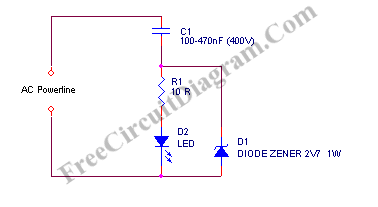
The high durability nature of a light emitting diode (LED) make it suitable for ON/OFF indicator application. Because the limitation on low operating voltage, LEDs are normally applied on low voltage application. Fortunately, there is a simple method to apply LED indicator for high powerline voltage: reactance of a capacitor can be used to limit the current without dissipating any power, this because the voltage at the capacitor differs 90 degrees from the current. Here is the schematic diagram of the circuit:

The zener diode is used to limit the voltage and to allow the current to flow in the reverse direction at the cycle where the the current flow cannot flow through the LED. Without this zener, the current will completely stop flowing since the the capacitor block the current whe it flows in one direction only. Capacitor selection determine the current setting, about 4 mA for 100nF and 20 mA for 470nF.
Possibly Related Articles:
- Self-Powered Current Sensing Circuit
This current sensing circuit sense the current at the high side (between positive supply and load). This circuit take the benefit of the microampere supply current and Rail-to-Rail input of... - Dynamic Compressor, Self Powered Circuit Design
This dynamic compressor will give about 20dB compression, at very wide input signal range 100 mV to 10 V. Another advantage of this circuit is that this circuit doesn't need... - AC Powered-LED Flasher
Based on a request by FreeCircuitDiagram reader Helynn Schufletowski, here we present an AC powered-LED flasher circuit for all of you! DEADLY ELECTRICAL SHOCK WARNING: This circuit is not isolated... - Battery Powered Electret Microphone Pre-Amplifier
Here is a schematic diagram of electret microphone pre-amplifier using LMV721 op-amp. because the LMV721 has low noise and low power features, it would be an ideal choice for battery... - Speaker Protector, Don’t Connect Your Speaker Before The Amplifier Is Powered
When you switch on your amplifier, you can see your speaker pop up with high power, and it can be harmful to your speaker. To make your speaker's life time...
|