Sponsored Links

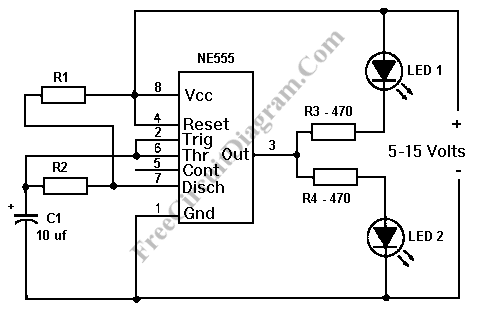
This LED flasher give similar circuit with the previous transistor LED flasher, but this circuit use a 555  integrated circuit chip as the active component. Here is the schematic diagram of the LED flasher circuit:

led flasher 555 circuit schematic

This circuit gives alternating LED flashing, but with different flashing period between LED 1 and LED 2. The ON period of the LED 1 is proportional to the R2 value, and the ON period of the LED 2 is proportional to R1 + R2 value. If you use a 1M variable resitor in series with a 22k resitor to replace R1, then you get a variable period flasher. The power consumption will be much lower if you use only LED 1 (remove the LED 2 and R4), and choose R2 value to be much lower than R1. This would give you a strobe effect since the ON period will be much shorter than the OFF period.


Possibly Related Articles:

  • AC Powered-LED Flasher
    Based on a request by FreeCircuitDiagram reader Helynn Schufletowski, here we present an AC powered-LED flasher circuit for all of you! DEADLY ELECTRICAL SHOCK WARNING: This circuit is not isolated...
  • 1.5V LED FLasher Using 3 Transistors
    LED flasher circuit here will flash a LED using only 1.5 volts  supply voltage. Normally, to make any LED lamp works, you need more than 2 volts power supply. This...
  • LED Flasher Circuit Using Transistors
    Classic LED Flasher Circuit This LED flasher circuit is a classic two transistor flip flop. This flasher circuit is very popular and it’s usually the first circuit to build when...
  • Simplest LED FLasher – Video Tutorial
    A LED flasher circuit can be built using only one transistor and few passive components. This circuit is a proof of Negative Resistance (the Esaki or Tunnel Diode in from...
  • Making A 555 LED Flasher – Video Tutorial
    In this video tutorial,  you can learn how to make a LED flasher circuit using 555 IC. The project uses a breadboard, so you don’t need any soldering work. A...