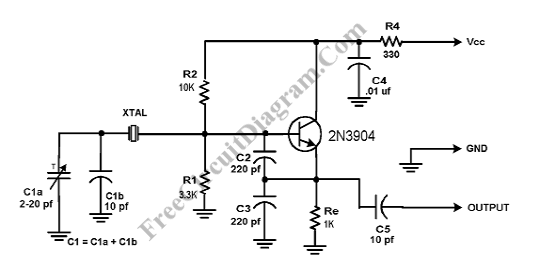
Crystal Colpitts oscillator can be implemented using a transistor and a parallel mode crystal. Here is the schematic diagram of the circuit:

In this circuit, the crystal acts as an inductance. A large value capacitive divider is used between gate, source, and ground, and a small series capacitor is placed in the crystal circuit. You should choose the components values so that C2+C3 to C1 ratio has the highest possible value. The ratio of 5 to 10 to 1 is usually used. The schematic shows the typical values. This circuit introduce a little loading on the crystal. The relatively high values of C2 and C3 “swamp out” variations and drift caused by variations in device characteristics. Frequency can be fine tuned with C1. A clean enough sine wave appears at the emitter of the transistor.
Possibly Related Articles:
- High Frequency Colpitts Crystal Oscillator
Op-amps has been widely used in low frequency oscillator (frequency <= 100kHz), but we can actually use it for high frequency crystal oscillator as long as we have an op-amp... - Stable Low Frequency Crystal Oscillator
This is a Colpitts-crystal oscillator circuit. It is suitable for low frequency crystal oscillator circuits. Using the 2N3823 JFET, this circuit has excellent stability because the temperature will not vary... - Crystal Oscillator Using Transistor, Capable of Overtone Operation
This circuit is a simple crystal oscillator that can be operated in overtone mode. Overtone mode permit the operation at higher frequency than specified by the crystal. The circuit uses... - Crystal Tester
A crystal tester circuit is very simple, it contains only oscillator and detector inside. This crystal tester circuit uses one transistor for the oscillator and one transistor for the detector.... - Temperature Controller for Crystal Oven
The temperature of a quartz crystal for oscillator should to be kept constant to operate at very stable frequency. This oven temperature controller is suitable for such purpose. Here is...
| 

