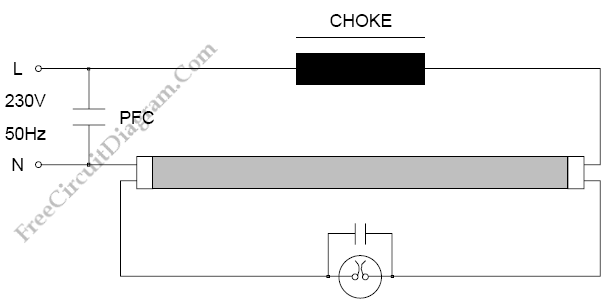
Simplicity, low cost and improved efficiency when compared with the alternative options are the reasons why the switchstart circuit has been widely adopted. Moreover, the 230V mains voltage is sufficiently higher than tube running voltage to let the use of the simple series impedance ballast in almost every case. Where the mains voltage is not high enough, for example in most 120V supplied circuits, a quickstart circuit incorporating voltage step-up is used to control the lamp.
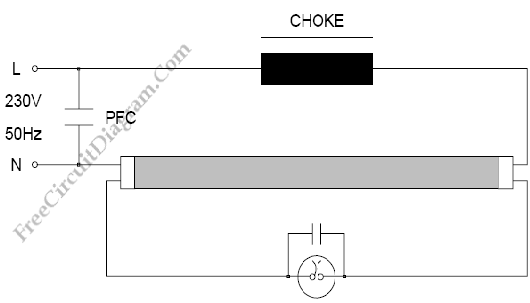
The lamp doesn’t light on first when the voltage is applied to the circuit, so the full mains voltage shows up across the starter via the choke and lamp cathodes. The starter is made of bi metallic contacts sealed within a small discharge bulb with an inert gas filling. The gas could be argon or neon. A glow discharge within the starter is caused by the mains voltage. This will heats up the bi metallic contacts, causing them to approach each other. When the bi metallic stay close, this will let preheat current to run through the choke and both cathodes.
The bi metallic contacts cool down and open since the glow discharge within the starter has now ceased. The voltage across the lamp increases rapidly and hit the lamp because the inductance of the choke tries to preserve current flow. The starter’s contacts close again and the cycle repeats if it doesn’t happen.
Current and voltage are controlled by the choke to the correct levels since the lamp has started at the firs time. The lamp running current is enough to maintain the cathodes (heaters) hot and sending out electrons without the need for separate heater supplies, which would otherwise be wasteful of energy. The circuit remains open because there is not enough voltage to cause a glow discharge in the starter since the lamp’s running voltage is much less than the mains voltage. Leading current from the mains is drawn by power factor correction (PFC) to counterbalance for the lagging current drawn by the lamp circuit. [Source: NXP Application Note]
Possibly Related Articles:
- IR2156 Electronic Ballast for CFL (Compact Fluorescent Lamp)
This is Electronic Ballast for CFL (Compact Fluorescent Lamp) circuit using IR2156. The IR2156 contains a high voltage half-bridge gate driver with a state diagram and programmable oscillator to make... - 12V Fluorescent Lamp Circuit
Fluorescent lamp or tube lamp (TL) has good efficiency. This high efficiency feature make it suitable for battery operated lighting application. To drive the tube lamp, we need high voltage... - Black Light (UV Tube Lamp) Inverter
The voltage boosting in this circuit enable its operation to be powered by 2.5 V rechargeable battery (two cells 1.2V rechargeable batteries), supplying 400 mA current at 26 V which... - Strobo Disco Light Using Standard Tube Lamp (TL)
Using a standard fluorescent tube lamp (TL), you can make your own disco light, similar to a stroboscope light. You can even use a half-broken lamp, which one side of... - L6569 Electronic Ballast
This is a electronic ballast circuit using L6569. This circuit uses The L6569 because it can control a low voltage halogen lamp transformer or a symmetric half bridge inverter of... - 10-20V Regulated LED Lamp
Resistor and LM317L act as a current regulator set to 40 ma. Current will flow from the battery through one pair of LEDs, and then to the regulator, through the... - Sound-Activated Lamp (Relay/Switch)
This simple circuit shown int the schematic diagram actives the switch using sound. We can use this circuit for various applications, such as automatic (sound-controlled) disco light or car’s LED... - Audio-Controlled Incandescent Lamp Light Controller
This is a audio-controlled lamp circuit. This circuit requires low voltage input such as pre-amplifiers, tone control, or general audio line level output. It’s also possible to feed the input... - Solar-Powered Garden Lamp with Light Sensor
Below is reverse engineered circuit diagram of yet another commercially produced solar garden lamp. To turn the light on at night, this depends upon a CDS photocell. It allows the... - Light Ignition Circuit
This is a circuit of light ignition circuit. This circuit uses the LIC01 which is designed for high voltage pulse generation circuits. This circuit can be used in many application... - Lamp Dimmer using 555IC PWM – Video Tutorial
This video is a tutorial of lamp dimmer using PWM. This video shows the use of PWM for lamp dimmer. In this video, the PWM kit uses a 555 IC.... - Wien-Bridge Oscillator Using Incandescent lamp Stabilizer
Incandescent lamp has been used to reduce harmonic distortion in sine oscillator circuit. The nonlinear resistance characteristic of the lamp filament help the circuit to shape the signal to approximate...
|