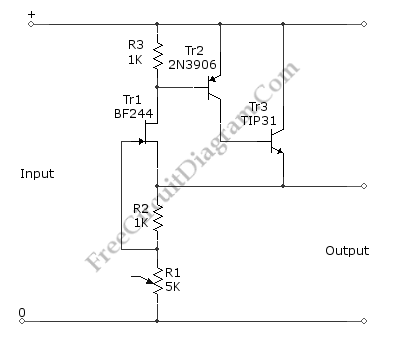
This voltage regulator circuit gives a stable 5V output from unregulated inputs (more than 5V). The stability of the output voltage is good enough, only change less than 0.1 volts when the load current changes about 60mA. Here is the schematic diagram of the circuit:
The basic principle of the voltage regulation rely on the mechanism of keeping the the FET’s gate voltage at the cut-off point. The FET’s gate volage is the voltage across R2. At zero volt (when there is no current flowing through R2), the FET will be conducting, and a small current at FET (Tr1) will cause much larger current to flow through Tr3. This current will flow through R2 and the gate voltage becomes negative. A some level the negative voltage at FET’s gate will cut-off the FETs current and keep the output voltage stable.
Possibly Related Articles:
- Discrete Voltage Regulator
It is still possible to build circuits without IC’s and still achieve a high level of performance while integrated circuits have become a staple of all modern circuit designs. A... - Direct High Voltage DC Regulator
This regulator circuit stabilize the output voltage at 200V directly (without a transformer). Although the output voltage is high, this circuit only suffer a tension of the voltage drop (Vinput-Voutput),... - Programmable Voltage Regulator Using L200 IC
This is a programmable voltage regulator circuit. With this circuit we can generate a voltage according to our wishes. This circuit uses L200 IC. Here is the circuit : Potentiometer... - Selectable Voltages 6V, 9V, and 12V Linear Voltage Regulator
We can build a multiple voltage power supply 6, 9, and 12V (AC-DC Adapter) with the circuit shown in the following schematic diagram. Not only provide multiple voltage output... - Automotive Voltage Regulator with Keep Alive Control
The LM9070 is a 5V, 3% accurate voltage regulator which have 250mA low-dropout. The regulator has an active low delayed reset output flag feature. This feature can be used to... - Low Drop-Out (LDO) Voltage Regulator Using Discrete Semiconductors
There are several integrated circuit chips designed specially for LDO (low drop out) voltage regulator. Building LDO using standard op-amp and discrete components can be an alternative. Here is one... - Low-Drop-Out (LDO) Low-Voltage Linear Regulator Using NCP2860 IC
This low drop out (LDO) voltage regulator need only few components, with very low noise and very low drop-out voltage. The circuit illustrated in the schematic diagram below gives a... - Foldback Current Limited High Voltage Regulator
This circuit is high voltage regulator which has foldback current limiter protection. This circuit uses LM10 comparator with voltage reference, and this core integrated circuit is connected directly to high... - How Discrete Voltage Regulator with Current Limiter Works
This discrete voltage regulator has complete features that is equivalent with modern voltage regulator integrated circuit (IC). It’s not cheaper if you build discrete one like this, but it’s always... - Soft Start Mechanism for L200 Voltage Regulator
The configuration in the circuit diagram below can be used when a slow rise time of the output voltage is required. We can find the rise time with following formula:... - Transformerless Voltage Booster Circuit: A DC-DC Step-Up Switching Regulator Using Transistors
A DC-to-DC step-up converter is traditionally implemented using transformer, working by converting the DC voltage to AC Voltage, step-up it using transformer, then rectify and filter the transformer’s output to ... - 5 A Constant Voltage-Constant Current Regulator
A constant voltage constant current (CVCS) regulator doesn’t mean a system with a constant load, since there will be no regulation in such case. What we call CVCS regulator is...

|