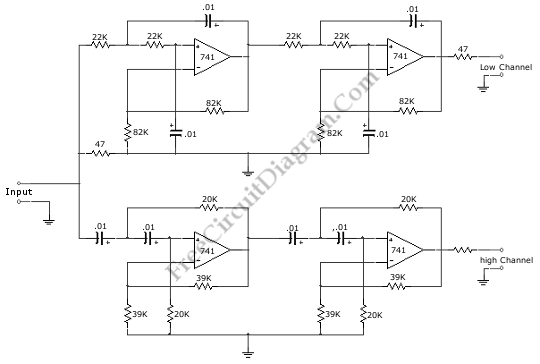
You might be familiar with passive crossover network installed inside your speaker box, consist of inductors and capacitors. The problem with passive crossover network is that they dissipate the audio power, so it’s not environmentally friendly, contributing a little disaster of global warming. Moreover, the capacitor and the inductor in the passive crossover network contribute [...]
Read the rest of this article [..]
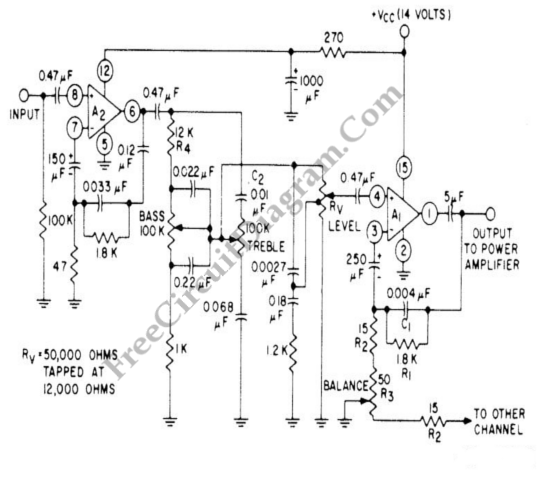
In high fidelity (hi-fi) audio system, the harmonic distortion level is kept as low as possible. To make sure that the amplifier handle the sigal perfectly, the response of many hi-fi audio systems is designed beyond the audio range, include the handling capability to process infrasonic (below 20Hz) and ultrasonic (higher than 20kHz) signals. Although [...]
Read the rest of this article [..]
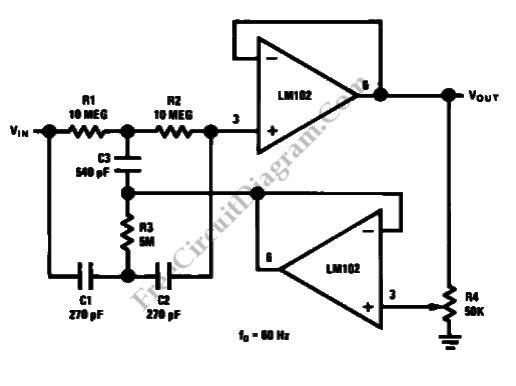
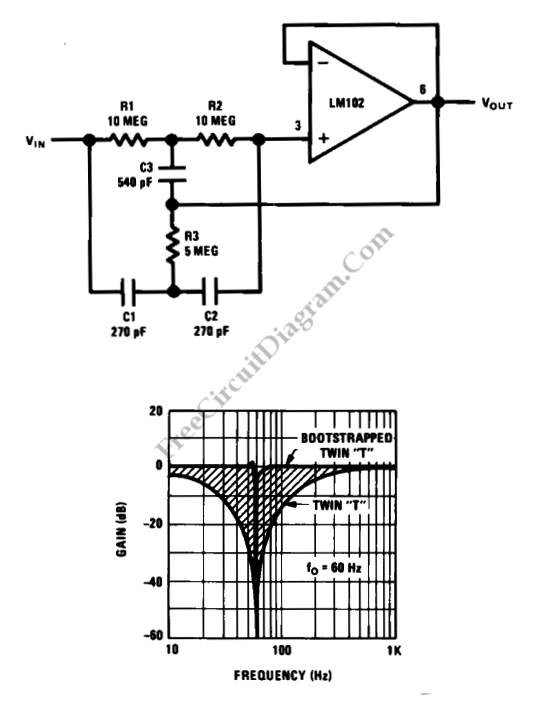
Notch filter is known as band-cut filter or band-reject filter. The fuction of this filter is to remove some frequency portion of a signal. The schematic diagram of this filter circuit, a second order notch filter is depicted in the figure below.
The formula is actually complicated, but by taking the R3=R4 and C1=C2, the filter’s [...]
Read the rest of this article [..]
The function of this circuit is similar with the hum filter in our previous circuit, but it use transistors instead of op-amps. It uses BC109 transistors, but any low noise high gain type will be suitable. This hum filter is adjustable via trimmer pots to fine tune it’s notch depth. The figure below shows [...]
Read the rest of this article [..]
The simple low-pass filter is shown in Figure below. The filter has a 20dB/decade roll-off after its corner frequency fc. Its low-pass frequency gain (f->0) is defined by R3/R1. This allows low-frequency gains other than unity to be obtained. R2 should be chosen equal to the parallel combination of R1 and R3 to minimize error [...]
Read the rest of this article [..]