FreeCircuitDiagram Articles Search
Custom Search


3-Band Graphic Equalizer Circuit

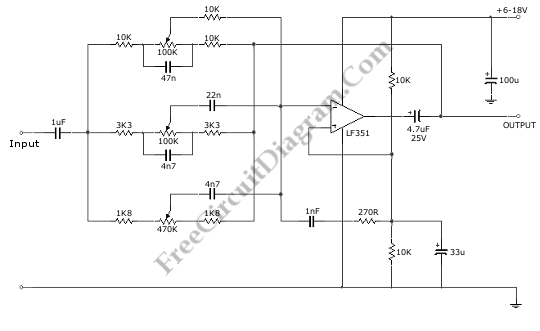
Unlike the 10-band graphic equalizer in our previous circuit that use a gyrator circuit, this 3-band graphic equalizer circuit uses Baxandall topology, similar with the Baxandall tone control but with additional mid frequency control. The figure below shows the schematic diagram of the circuit.

The operational amplifier employ an LF351 IC chip, but any low noise [...]


Read the rest of this article [..]

Baxandall Tone Control Using LM833: The Circuit’s Schematic Diagram and The Formula

This circuit is similar to our previous tone control circuit, a bass-treble tone control circuit, but here we present the formula for design your tone control’s custom frequency response. Here is the schematic diagram and formula of the tone control circuit:

Almost all op-amp type can be used, as long as they have high input impedance, [...]


Read the rest of this article [..]

10-Band Graphic Equalizer Using Gyrator Circuit

Graphic equalizer is a filter which it’s overal frequency response can be adjusted easily by sliding the potentiometer knob, and the potentiometer’s knob positions will naturally mimic the frequency response of the filter, and this is very user friendly. Many methods have been developed by electronic engineers to make audio equalizer, such as Baxandall’s [...]


Read the rest of this article [..]

Baxandall Tone Control Using CA3140 Op-Amp

Operational amplifiers for tone control circuit application require high slew rate, wide bandwidth, high input impedance, and high output current characteristics, and CA3140 is suitable for this purpose. Look at the following tone control circuit’s schematic diagram for the design.

The tone control circuit in the figure above use a very popular Baxandall tone control configuration [...]


Read the rest of this article [..]

Baxandall Tone Control Using Two Transistors

This tone control circuit use very popular Baxandall configuration, a simple circuit configuration that provides boost and cut control in continuous manner. This circuit is very cheap to build, and it’s commonly implemented in commercial product. Here is the circuit’s schematic diagram:

The transistors can be substituted by any general audio transistors with small current gain [...]


Read the rest of this article [..]