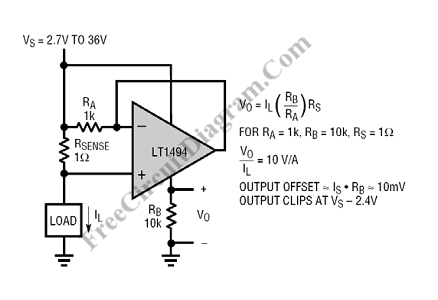
This current sensing circuit sense the current at the high side (between positive supply and load). This circuit take the benefit of the microampere supply current and Rail-to-Rail input of the LT1494 op-amp. Here is the schematic diagram of the circuit:

Look at the op-amp, the inverting input is connected directly to the output, and this negative feedback will keep the inverting input to be in the same level with the noninverting input. This mans that the voltage across RA will be kept equal to the voltage across Rsense. This voltage make the current flows from the power source source to the output pin of the op-amp through RA, and finally return to ground via RB. Almost all of the current at RB comes from RA since the internal circuit draws only very small amount of current through Vcc pin, so the output at RB is valid. [Circuit schematic diagram source: Linear Technology Application Notes]
Possibly Related Articles:
- Current Sense Circuit, A Classic Design Using Positive Rail Sensing
A LT1637 is advertised as 1.1MHz, 0.4V/us Over-The-Top Micropower, Rail-To-Rail Input and Output Op Amp. This features are suitable for current sensing application since input voltages are right at the... - Current Sensing for High Voltage Application
High voltage current sensing/monitoring can be designed using LTC6101 op-amp. The following current sensing circuit is capable of measuring electrical current in 500 volts system. Here is the schematic diagram... - High Side Current Sensing for Low Side Switching
An AD8205 can be used to make a high-side current sense with a low side switch. Besides AD8205, an inductive load (solenoid) and a resistive shunt are added in this... - High Side Current Sensing for High Side Switching
Sometimes, there are unexpected solenoid and excessive corrosion occurs on current sense circuit. Corrosive effects can be occurred because of the differential voltage between the ground and the load. To... - Differential Current Sensing Inside H Bridge
A differential current sensing that is inserted inside a H bridge circuit. is shown in the schematic diagram below. This circuit is one example of AD8205 application. The AD8205 measures...
|