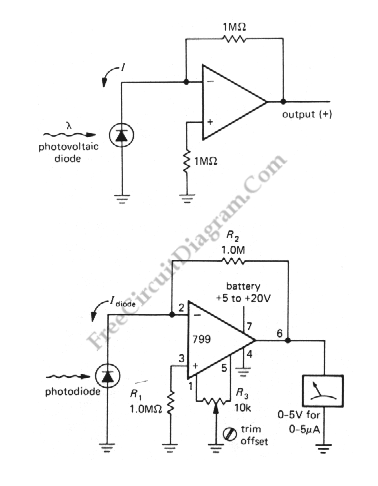
The simplest I to V converter is the humble resistor. However, presenting a nonzero impedance to the source of input current is the disadvantage of the humble resistor. If the device providing the input current has very little compliance or does not produce a constant current as the output voltages changes, this can be fatal. A photovoltaic cell is a good example, a fancy name for a sun battery. Even the garden-variety signal diodes you use in circuits have a small photovoltaic effect (there are amusing stories of bizarre circuit behavior finally traced to this effect). The circuit below show us the good way to convert current to voltage while holding the input strictly at ground.

Ideal current to voltage converter circuit schematic

Since a photovoltaic diode can generate only a few tenths of a volt, the inverting input is a virtual ground (this is fortunate). The output of this particular circuit is 1 Volt per microamp of input current. The resistor from the noninverting input to ground could be omitted, but it is highly desirable The function of this resistor will be explained shortly in connection with op-amp shortcomings.


Possibly Related Articles:

  • LF356 Wide Range Current-To-Voltage Converter
    Current to voltage converter circuit can be made using a single resistor, it is very simple since any current will naturally develop a voltage when flow through a resistor. Using...
  • Current to Voltage Converter
    In the simplest form, current to voltage converter can be implemented as simple as one resistor,  since a voltage is developed when an electrical current flow against a resistance. The...
  • Programmable Photovoltaic Transimpedance Circuit
    Photovoltaic transducers has been widely used in medical, consumer, scientific instrumentation, and industrial applications. Photovoltaic sensors is a solid-state devices and available for wide range of wavelength response, cover from...
  • Single-Cell Voltage Monitor
    Monitoring battery voltage can be important in some application.  Some battery monitor will be simply a continuous LED lamp which is dimming according to the voltage level. Here is presented...
  • PolyPhase DC-DC Converter: Voltage vs Current Mode Control Sharing – Video Tutorial
    This is a voltage vs current mode control current sharing in a poly phase DC-DC converter video. This video explains the different of the voltage and current mode control in...
  • Photocells (Photoconductive, Photodiode, and Photovoltaic) Amplifiers
    The figures below show us about amplifiers for photoconductive (top),  photodiode (mid) and photovoltaic cells (bottom). Some voltage dependence of both speed and linearity is displayed by all photogenerators. If...
  • Single Cell Battery Meter Amplifier
    A meter amplifier can be designed using LM10 integrated circuit (IC). The accuracy of full-scale sensitivity is good for over 15°C to 155°C at 10mV and 100nA.  Here is the...
  • Single Cell Battery 1.5V 20dB Inverting Amplifier
    Featuring very low power consumption, 675 nA is the total current  consumption for this amplifier  circuit. The output voltage swing is 300 mVpp with a 20 kΩ load. This very low...
  • A/D Conversion with Voltage-to-Frequency Converter
    To accomplish A/D conversion with V/F converter in a microcontroller system, there are two schemes that can be utilized. First, VIN is measured by counting the FOUT frequency for 1ms,...
  • Voltage-Current(V/I) Curve Tracer
    Voltage-Current curve tracer is very important tools for components ant circuits troubleshooting. This circuit need an oscilloscope with X-Y inputs to display the curve. This circuit provide adjustment for both...
  • Voltage and Current Limited Audible Continuity Tester
    Using this continuity tester circuit, a failure of  PCB tracks be examined without looking directly at the tracks routing, which is can be very frustrating. The indication of this circuit...
  • Chromel Alumel Thermocouple Current Loop Transmitter
    The schematic diagram below show signal conditioning circuit for remote current loop temperature transmitter. This thermocouple temperature transmitter is loop powered, means it doesn’t need its own power supply since...