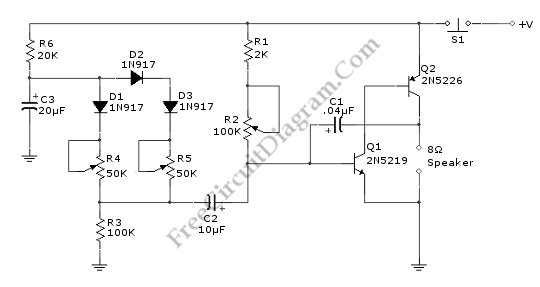
This doorbell circuit produces a low tone that will slide up to higher frequency. The equivalent total resistance connected between the base of Q1 and ground (Rbg) , and coupling capacitor C1 determines the AF oscillator’s frequency. The resistance (Rbg) is equal to (R2+R1)R3. Here is the schematic diagram of the circuit:

The R2 is used to set the initial bias condition, adjusted to produce a pleasant low starting frequency doorbell tone. D1 will start to conduct when Capacitor C3 charge through R6 until it reaches D1 bias voltage level. Then the value of Rbg is paralleled by R4 and D1, and R5-D2-D3, and the values of diode’s equivalent resistance is gradually decreased as the C3 voltage ramp up. This decreasing resistance value make the output tone slides up in frequency. Two different diode path is provided to extend the linear area of diode conduction transition slope. With two path with different biases, after the single diode path has saturated, the second path provide further linear increase at higher voltage level.
Possibly Related Articles:
- Frequency/Tone Decoder with TC9400 FVC
Another application of FVC (frequency-to-voltage converter) is tone/frequency decoder. This circuit is used to determine the frequency band of an oscillation signal. This circuit is used in many application like... - Tone/Frequency Detector (Decoder)
We can use tone/frequency detector (decoder) to detect the presence of a signal with a certain tone. The output of the circuit will be active if the signal is the... - 555 IC Linear Ramp (Sawtooth) Generator/Oscillator
The Vc1 increases linearly when the pull-up resistor RA in the monostable circuit is replaced with constant current source, generating a linear ramp. The linear ramp generating circuit and the... - Discrete 9-12V Microphone Pre-Amplifier
This is a microphone pre-amplifier circuit that use discrete components. The gain of this circuit is 100 and should be enough for most microphones. It is set by the ratio... - Discrete (Transistors) Audio Mixer
This audio mixer is built with transistors. This audio mixer circuit is unique, not based on low input impedance amplifier. Most of audio mixer circuit is based on low impedance... - Discrete Bass Booster Circuit
This bass booster circuit can be used filter the input signal as part of internal circuit of an active subwoofer circuit. This circuit is not only boost the bass (low)... - Small 2 Watts Discrete Amplifier
For anyone who love transistor circuits, here you can find small wattage discrete amplifier. Building discrete amplifier is much more fun and some people say it’s involve more artworks than... - Microphone Pre-Amplifier with Tone Control
Microphone can’t be directly connected to a power amplifier because the signal is too weak. Standard audio power amplifier accept about 1 Vrms to give a full volume (maximum power),... - Baxandall Tone Control Using CA3140 Op-Amp
Operational amplifiers for tone control circuit application require high slew rate, wide bandwidth, high input impedance, and high output current characteristics, and CA3140 is suitable for this purpose. Look at... - Baxandall Tone Control Using Two Transistors
This tone control circuit use very popular Baxandall configuration, a simple circuit configuration that provides boost and cut control in continuous manner. This circuit is very cheap to build, and... - HI-FI Tone Control Circuit (High Z Input)
This is a HI-FI tone control circuit with high Z input. This circuit is used to control HI-FI tone. Here is the circuit: To buffer op-amp operated feedback type tone... - Stereo Tone Control with National 3D Sound
The LM4610 uses DC signal to control the tone (bass/treble), volume, and balance circuit. The advantages of using DC control is that you can use a mono potentiometer to control...
|