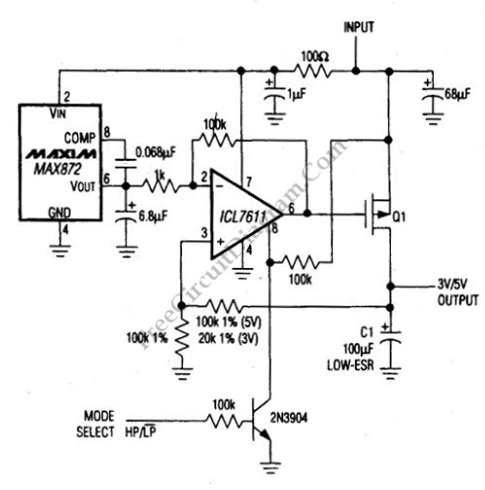
Three NiCad and NiMH batteries can be used to produce 3V/3.3V supply voltage. This can be done by this linear regulator circuit. This circuit uses an ICL7611 micropower op amp and MAX872 voltage reference. This regulator can be used to replace the charge pump or a switching regulator. The dropout characteristics of this circuit depends on the characteristics of Q1. The Q1 must have a gate-threshold voltage below the lowest battery voltage when this circuit is used with low voltage like a three-cell battery. Here is the schematic diagram of the circuit:

3 V 3.3 V from three cells with linear regulation circuit schematic
This circuit requires input voltage from 3V to 15V. This circuit has two mode, high power mode and low power mode that can be selected by logic at the MODE SELECT input. With Vin 6.5V, the quiescent current is 70µA when operated in high power mode and decrease to 40µA when it is used in low power mode. This circuit has maximum load power of 5mA in low power mode and 1A in high power mode.


Possibly Related Articles:

  • Stable 5v from Old Cells
    The benefit of stepping down the voltage of the battery is that we can give a constant/stable performance for our devices until the battery runs out the power. That’s only...
  • Regulated +15 -15 Volts Symmetric Power Supply From 12 Volt Transformer
    If you need +-15 Volts supply and you have only a standard 12V AC transformer, don’t be hurry to buy a new one with center tap, you can use your...
  • 10-20V Regulated LED Lamp
    Resistor and LM317L act as a current regulator set to 40 ma. Current will flow from the battery through one pair of LEDs, and then to the regulator, through the...
  • Selectable Voltages 6V, 9V, and 12V Linear Voltage Regulator
      We can build a multiple voltage power supply 6, 9, and 12V  (AC-DC Adapter) with the circuit shown in the following schematic diagram.  Not only provide multiple voltage output...
  • 5 A Constant Voltage-Constant Current Regulator
    A constant voltage constant current  (CVCS) regulator  doesn’t mean a system with a constant load, since there will be no regulation in such case.  What we call CVCS regulator is...
  • TLC497CN Negative Supply Generator
    Negative supply from positive supply is needed if the circuit need both positive and negative supply while we have only positive supply. The circuit shown in the schematic diagram below...
  • Direct High Voltage DC Regulator
    This regulator circuit stabilize the output voltage at 200V directly (without a transformer). Although the output voltage is high, this circuit only suffer a tension of the voltage drop (Vinput-Voutput),...
  • 0-50V 1A Laboratory Power Supply
    Laboratory power supply is characterized by its wide adjustable voltage range and its robustness. Continuous voltage adjustment is necessary, as well as current limiter for safety and robustness. You can...
  • How Discrete Voltage Regulator with Current Limiter Works
    This discrete voltage regulator has complete features that is equivalent with modern voltage regulator integrated circuit (IC). It’s not cheaper if you build discrete one like this, but it’s always...
  • Precision Power Regulator with Low Temperature Coefficient
    Making a precision voltage source is easy, but not so easy if the voltage should be consistent over wide range of ambient temperature. Such requirement might be needed in high...
  • Programmable Voltage Regulator Using L200 IC
    This is a programmable voltage regulator circuit. With this circuit we can generate a voltage according to our wishes. This circuit uses L200 IC. Here is the circuit : Potentiometer...
  • High Efficiency Switch Mode 3.3V 5A Step-Down Converter
    This switch mode step-down converter has very good efficiency, up to 94% can be obtained. This switch mode regulator uses LTC1266-3.3 controller with external N-Channel power mosfet, and need only...