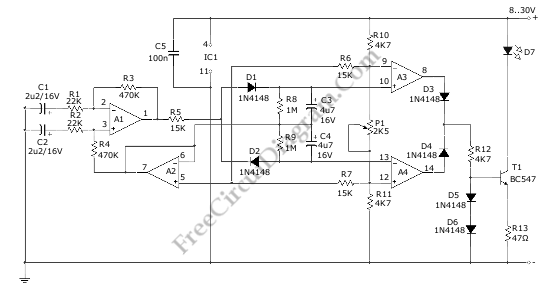
For any electrically conductive liquid level measurement, this single chip circuit is very compact and simple. This circuit is an ac excited fluid level sensor, which uses alternating current to provide biasing for the sensor probe to avoid electrolysis of the probes. This ac excitation makes the sensing probe has longer lifetime. This circuit can [...]
Read the rest of this article [..]
Metal Detector Circuit Topology
One of the simplest method of metal detecting is by beat frequency oscillator. Basically, the circuit consist of two balanced oscillator. One oscillator provides the reference signal, and other oscillator is acting as the detector element. The reference oscillator’s frequency is fix, while the detector oscillator is variable depending on the presence [...]
Read the rest of this article [..]
XTR105 is a 4-20mA current loop transmitter integrated circuit, with two precision current sources. The Instrumentation amplifier gain inside this chip can be configured for a wide range of temperature or pressure measurements. This integrated circuit chip provides current excitation for platinum RTD temperature sensors and bridges, instrumentation amplifiers, and current output circuitry on a [...]
Read the rest of this article [..]
RCV420 is a special function integrated circuit chip for 4-20mA current loop receiver. RCV420 provide complete 4-20mA to 0-5V conversion, with 0.1% overall accuracy, 86dB CMR, and ±40V common-mode input range. This IC chip is suitable for many applications:
PROCESS CONTROL
INDUSTRIAL CONTROL
FACTORY AUTOMATION
DATA ACQUISITION
SCADA
RTUs
ESD
MACHINE MONITORING
Here is the schematic diagram of the basic 4-20mA current loop receiver [...]
Read the rest of this article [..]
AN6884 is a logarithmic scale LED bar display driver. AN6884 accept wide range of supply voltage, ranging from 3.5V to 16V. This VU (voltage unit) bar display circuit provides only 5 levels, but will accept wide range of input level because the scale is logarithmic: -10, -5, 0, 3, and 6dB points. The output current [...]
Read the rest of this article [..]