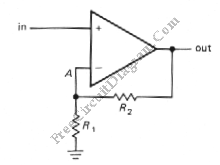
This is a Inverting amplifier circuit. This circuit is used to amplify the application that requires large(closed-loop) voltage gain since it has low input impedance. The output of this circuit is an amplified signal with different phase wit the input. This circuit uses a feedback. Here is the schematic diagram of the circuit:

The R1 is 10K and R2 is 100K, and the input voltage is +1V. A voltage divider is formed by R2 and R1 that hold the inverting input at +0.91V. When the input is unbalance, the output is forced to go negative until the output is at the needed, +10V. At that point, the both op-amp inputs are at the same voltage. When the input voltage is below the ground, the op-amp force the output voltage to rise. The voltage gain of this circuit is determined by following equation:
Vout/Vin = – R2/R1
And the input impedance is R1.
Possibly Related Articles:
- Single Cell Battery 1.5V 20dB Inverting Amplifier
Featuring very low power consumption, 675 nA is the total current consumption for this amplifier circuit. The output voltage swing is 300 mVpp with a 20 kΩ load. This very low... - Non-Inverting Operational Amplifier Circuit’s Noise – Video Tutorial
Below is video tutorial about a noise of a non-inverting operational amplifier circuit. On this video, we are explained about how to calculate the noise of a non inverting amplifier.... - Non-Inverting Comparator With Histeresis
This circuit has similar function with inverting comparator with hysteresis, but the output is not inverted. The output will be high if the input is higher than the upper threshold... - Inverting Comparator With Hysteresis
Comparator with hysteresis (Schmidt trigger) can be built using LM339, LM239, LM2901, LM2901V, NCV2901, or MC3302 quad single supply comparator integrated circuit chips. Here is the circuit’s schematic diagram and... - Summing Amplifier with Op-Amp
One of inverting amplifier application is for summing several electric signals. The output of this circuit produce the sums of the input voltages. We can use both positive or negative... - Differential Amplifier with Op-Amp
The schematic diagram below shows a differential amplifier circuit. This circuit is used to get a common-mode rejection ratios. This circuit need a precise resistor matching to get common-mode rejection... - Noninverting Amplifier with Op-Amp
This is a noninverting amplifier circuit. This circuit amplify the input voltage with the same phase with output voltage. This circuit has infinite input impedance, but using 741, the input... - Pre-Amplifier Circuit for Oscilloscope
An oscilloscope amplifier with 20 dB voltage gain is provided by this circuit with a frequency range from 0.5 to 50 MHz. By increasing the value of the 0.05 uF... - Logarithmic Amplifier Using MC1556 Op-Amp
The circuit below is a logarithmic amplifier using an MC1556 op amp. The 10K pot is an offset adjustment. Here is a schematic diagram of one classic example of general... - Fast Logarithmic Amplifier
This is Fast Logarithmic Amplifier circuit. Dynamic range of This circuit has is 80 dB. This circuit is configured to optimize speed rather than dynamic range. To allow the use... - Two Op-Amps Instrumentation Amplifier
For standard instrumentation amplifier, a three op-amps instrumentation amplifier circuit is common, but if you need smaller component count and lower cost, you can use just two op-amps for the... - Three Op-Amps Instrumentation Amplifier
Using LMV721/722 or any other high impedance op-amps, you can build an instrumentation amplifier using standard three op-amps instrumentation amplifier circuit. The figure below shows the circuit’s schematic diagram. The...
|