Archive for the ‘Power Supply’ Category
Over/Under Voltage Monitor

This is a over/under voltage monitor circuit. This circuit is used to monitor Any potential from 1 to 15 V. If there is a undesirable variation was occurs, two lamps will flash. The voltage differential fro lamp turn off and turn off is about 0.2V at any setting. Low and high set points are independent …[Read More]
Toggle Push Button with Press and Hold

Look at the schematic diagram of a circuit below, imagine if the capacitor C1 is not charged and the power is off. There will be no current flow and Q3 will be open. The Base of Q3 will be high and the Base of Q2 low. The circuit is in stable condition and nothing happening. …[Read More]

Programming old EPROM devices needs high voltage, and this is a circuit of high repetition rate Vpp programming supplies. This circuit is used for memory programming that need higher repetition rate. This circuit produces the Vpp continuously by the switching regulator that runs continuously. To preclude any possibility of inadvertent Vpp output, the switching regulator …[Read More]
AC Line Dropout (Power Failure) Detector

Power dropout detection is often required by digital system driven from the AC line. A memory store command to be issued before DC power falls is allowed by fast AC line drop out detection. The circuit on figure below detects AC dropout by connecting an optoisolator across the power transformer’s rectified secondary. Normally, the LED …[Read More]
Basic Flash Memory Programming Voltage Supply

This is a Basic Flash Memory Programming Voltage Supply circuit. This circuit uses LT1072 switching regulator to generate high voltage by driving the L1. R2 and R2 provide DC feedback for this circuit. R3-C2 and C1 control the SC roll-off. This circuit can generate supply of 12V or 12.75V depended on the R1 values. To …[Read More]
Circuit Breaker

We can use a circuit breakers to limit the current in a single circuit in most household applications. Although breakers come in many sizes, typically a single circuit is limited to 20 amperes. This means that to bend it downward and release the spring-loaded trip-lever, 20 amps of current will heat the bimetallic strip. Another …[Read More]
Reduced Hysteresis Diac-Triac Phase/Power Control
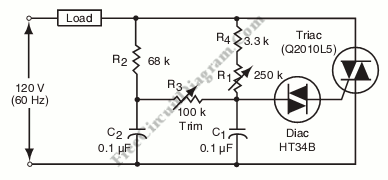
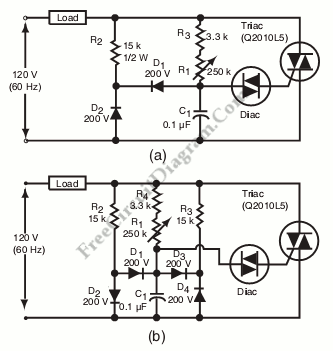
This is a Reduced Hysteresis Diac-Triac Phase/Power Control circuit. This circuit is used to control from 5% to 95% of full load power. This circuit can decrease the hysteresis effect to a reasonable region. It can be done because this circuit uses second RC phase-shift network. Beside that, the second RC phase-shift network also extends …[Read More]
|